It's all about...popular girls...rec rooms...summers at the lake...dates with wealthy, thrill-crazy boys...black-market antiques...small town political corruption...and finding your true path in life. The Paris Hat considers the sometimes frothy, sometimes serious world of novels for teenage girls from the 1950s and 60s.

Monday, November 29, 2010

Year of Living Tamely

Title: Senior Year
Author
: Anne Emery
Publisher: Scholastic, 1964 (paperback reprint, originally published 1949)
Provenance: Formerly the property of Elena Sipp
Setting: a small town so generic it doesn't even have a name
Fun: plant sitting; babysitting; church youth group; "Captain Midnight" on the radio
Quote: In the garden she chose white and yellow chrysanthemums and achieved an arrangement in a low yellow bowl before Jean finished the table. Then she discovered that Jean had used pink placemats and refused to change them just to carry out Sally's color scheme. "All right then," said Sally, with conscious patience, "only it would be nice to have the first dinner at home as perfect as possible."

Senior Year was published in 1949, a fact that becomes obvious when someone asks Sally if she likes her music "smooth" or "hot" (i.e., Bing Crosby or Glenn Miller style.) I have to wonder if the kids who picked up this book in 1964 weren't confused by that, or if the absence of rock'n'roll didn't matter to them. Interestingly enough, this must be the fifth or sixth book in which some of the characters listen to folk music (in this case Sally's parents, who go in raptures over John Jacob Niles.) In other books it's been the teens who listen to it. I know that folk had a vogue in the early 60s, but I sometimes wonder if it isn't the adult writers putting their own tastes onto the characters. In any case, I've never run across a book from this era yet with any appreciation for rock'n'roll.
It's hard to say exactly what the main plot of Senior Year is. There's a Mr. Right and Mr. Wrong, a fast boy called Eddie who takes Sally to a sleazy bar. There's a somber subplot involving a sister who gets rheumatic fever (also probably anachronistic by 1964) and spends months in the hospital. Bills pile up, and at the end of Senior Year Sally is told by her parents that they can't afford college for her unless she goes to the local state university. Sally doesn't object to the educational qualities of this institute, rather:

"Everyone she knew was going away. There wouldn't be anyone left in town. It was the one tragedy she had thought wouldn't happen to her."

Sally cheers up, eventually, when she learns that Mr. Right will be going to college locally, too.
There is a vague stirring behind all this action which seems to suggest that Anne Emery wants Senior Year to be about growing up and thinking of things beyond your own narrow viewpoint -- e.g., giving up the dream of attending a certain college when you realize you little sister may be crippled for life. But it doesn't really feel like that. It feels more like settling for less and pretending you like it.
Which, as a concept, was also pretty anachronistic by 1964.


Thursday, November 4, 2010

Washington is for Lovers

Title: Cherry Blossom Princess
Author: Marjorie Holmes
Publisher: Westminster Press, 1960
Jacket: not credited
Setting: Glamorous Washington D.C.
Provenance: formerly the property of the Sacramento County Library
Fun: Shopping, parades, politics, revenge
Quote: "Where in the world did you get all this stuff?" was all that Marty could think to exclaim.
"Oh, hither and yon," Kitty said, hanging her mink jacket in the hall closet..."The rug's a genuine Saruk. We got it in Bagdad for a song. That inlaid mother of pearl cabinet's a present from Madame Chiang Kai-Shek. The tray's from Haile Selassie. The Delft clock -- isn't it cute, all the moving figures? -- is from the Dutch queen."
If you look up Marjorie Holmes on Ebay or any other used bookseller website, you will find quite a lot of inspirational books, both fiction and non-fiction. Her young adult stuff is harder to find, and this book in particular is considered quite rare -- I've seen copies in top condition listed for $30 or $40. (I jumped on $13 for a ex-library copy in fair condition as a bargain.) My guess is no one can resist either the title or the cover.
In real life, Holmes lived in Washington DC, and between books she wrote a newspaper column on family issues*. She came from Iowa, and she gives this same origin to Marty of Cherry Blossom Princess. Marty is sent to visit her aunt and uncle (a VIP in the State Department) in DC to get her mind off being dumped by her boyfriend, Don. In a matter of pages, her aunt and uncle fix it up that Marty will be Iowa's entry into the Cherry Blossom Princess festival, and in another trice Marty has 1) boy next door Mike, 2) charming but engaged official escort Skip, 3) poor old Don, whose high school band has come to Washington to participate in the festival, all trailing after her.
The great success of Cherry Blossom Princess is in its Cinderella evocation of a certain phase of adolescence: on the verge of being an adult and yet still only pretending to be one. Marty and her various escorts and boyfriends go to restaurants and dances and "parties in someone's apartment in Georgetown"; they roam Washington after dark, gazing at the monuments and uttering civics-class sentiments. Marty cries into her pillow at night and spends hours waving from a parade float the next morning. It's a whirlwind of glamor, heartbreak, springtime and emotional exhaustion. And yes, I was a tiny bit jealous, though I remember that feeling well. (A Marriott Hotel in Louisville, Kentucky can seem mighty glamorous when you're seventeen.)
Eventually the party ends and Marty walks off with Mike, glad to be over Don and free of Skip. You get the feeling, though, that Iowa will never seem the same.

 
*ETA:  I did not do my research properly on Holmes.  She was best known as the author of Two from Galilee (1972), the first of a trilogy about the courtship of Mary and Joseph and the adolescence of Jesus.  Two from Galilee is very reflective of an era in which the humanity of Jesus as an ordinary person was often stressed (see Godspell and Jesus Christ Superstar, for instance.)  Let's just say the book is sort of...earthy, although any book in which the Virgin Mary gets her period on the first page  deserves some credit, I think.
-- August 2014

Thursday, October 21, 2010

West Coast Story

Title: Sunday Dreamer
Authors: Bob and Jan Young
Publisher: Julian Messner, 1962
Setting: Seaside Cordoba, California
Provenance: unknown, but sometime around 1971 was owned by someone who lived in Bismarck, North Dakota
Fun: Grandma vs. the zoning board; school rivalry; vandalism
Quote: "For years we've prided ourselves that Cordoba didn't have a juvenile delinquency problem but this situation between the high schools is getting out of hand. It's beginning to look more and more like some of that outright gang warfare you hear about in the big cities."

Do people still write books about girls who just want to be popular? How exactly did it come about that popularity became synonymous with evil and the popular girl a cardboard character who represented every negative value? As I remember high school the popular girls were flimsy, airheaded creatures who didn't bother much with girls like me (something I didn't resent) and who hardly had the impetus or time to go around destroying the lives of lesser mortals, or even saying nasty things to them. High school wasn't war, high school was indifference -- which can actually be much, much worse.
In books from this era, however, popularity is rarely portrayed as a negative thing. Every heroine wants to have lots of friends and be among the class leaders, all of whom are nice, normal girls. True, the occasional cat shows up in their ranks, but her sharp tongue usually causes her downfall before long. After all, who would want to be friends with someone who isn't nice?
So this brings us to Sunday Dreamer. Moving to Southern California from San Francisco, where she had one friend at school, is a fresh start for Nancy. Her grandmother's social position as foundress of the town ought to help, too. But Nancy tries too hard, she's too studied in her "witty" responses to friendly questions, she takes offense too quickly, and before you know it she's eating lunch all by herself in Cordoba, too.
Given that being popular is synonymous with being normal, no-one questions that Nancy is right in wanting it. She just has to go slow, and since this book is by the Youngs, Nancy's journey will involve something serious and thought-provoking. In this case, nursing. Nancy volunteers at the hospital, she brings in other girls to help, she unites two feuding high school gangs, and she pulls an all-nighter after a train accident. After all that, who the hell cares about being popular?

And thanks to Carole Anne Carr, who gave me a Literacy Builder Award this week. I posted my five favorite words and passed it on to three other bloggers on my other blog, Pray for Rain. Thanks again, Carole Anne.

Tuesday, September 21, 2010

One of the Girls

Title: Tomboy
Author: Barbara Clayton
Jacket: Lucille Wallace
Publisher: Funk & Wagnalls, 1961
Setting: chilly New England
Provenance: "Ludwig, 1962" written inside front cover
Fun: beating up boys who call your brother a sissy; a school assembly about missiles; scaring old ladies on Halloween
Quote: It was getting dark and the game was about to break up when Percy Hill, carrying the ball, headed in Gabby's direction. Without a second's hesitation, she stuck out one foot and jabbed an elbow in his ribs at the same time. Percy hit the ground with a thud.

With a book called Tomboy, football is a given. So is the discovery, by the end of the story, that dresses, boys and dates are wonderful as well.
Gabby's problem is not so much era-appropriate gender identification as the existence of the rest of her family. Her twin brother plays the violin. (Thus she has to beat up the boys who tease him.) Her mother, who is French, buys the wrong kind of clothing for her -- frilly, frothy stuff. (Thus school dances are a misery.) When these problems are sorted out, Gabby begins a swift upward climb, eventually becoming a model of sports clothes in a local department store and winning the Women's Club essay contest.
There is an extra twist in this book, and it's caused me to create a new tag, called "I Want to Be A Writer." Like Judy, in I, Judy and Kathy in Stranger No More, Gabby, inspired by a neighbor who writes picture books, takes up the pen. She writes a picture book of her own, about a mythical Maine animal called a sidehill-gouger, and even sits in on what would today be called a critique group with her neighbor. Clayton is careful to show that writing is hard: Gabby doesn't like the criticism she gets there, and she abandons the story, only to take it out of the drawer again later.
As she did in Skates for Marty, Clayton tends to overload her characters with good things at the end of the book: Gabby is not only a model and essay winner but she is admitted to a prestigious summer writing class (the kind, I imagine, that Sylvia Plath tried to kill herself when she didn't get into.) Plus there's a boy or two. But Tomboy, in spite of it's ending, isn't a sellout. Gabby remains a character who knows she looks better in ski clothes than frilly dresses.

Wednesday, September 8, 2010

4H Dropout

Title: Sweet Sixteen
Author
: Anne Emery
Jacket: Georgeann Helms
Publisher: Macrae, Smith, 1956
Setting: Marquette, Indiana, two hours by bus from Terre Haute
Provenance: "Kathy Himsl" written in front cover
Fun: how to be a juvenile delinquent in 6 easy lessons; training a heifer ; a school bond issue
Quote: "You do the strangest things," marveled Bunny. "That 4-H all the time -- and orchestra. Don't you ever have any fun?"

Don't be deceived by the innocent cover! There are bad girls in this book! Bad, bad girls! Girls who laugh at the 4-H club! Girls who order hamburgers in drugstores at 12:30 at night! And bad boys, too! You know, grease monkey types, always fixing cars!
OK, I'll stop, but I do want to at least give Anne Emery credit for landing herself with a subject that most YA writers today won't touch. Any kind of mutation or peril is fair game, it seems, but an ordinary girl who gets bad grades and thinks she's dumb? A girl who doesn't even like to read? You've got to be kidding. What kind of a protagonist is that?
Jane Ellison was also the heroine of an earlier Emery title, Hickory Hill, in which she bought a calf and developed an interest in farming (and farmboys.) Now, like a typical sixteen year old, Jane has moved on. She's going to high school and she has sarcastic Mrs. Shelby who won't explain the difference between the Pilgrims and the Puritans and there's no point in trying to please her. After all, her new friends Bunny and Rita are positive that there's only one thing really important in life:

"I say a girl's first job is getting a husband," Bunny announced..."It's not as easy as it looks, either. That's why I'm not going to let Stan go until something better comes along. At least he's got a job."

It should be noted that Emery distances herself from this attitude by having Jane's mother later say, "Bunny and Rita don't seem like our kind of people."
Sweet Sixteen would be more meaningful if we could see how Jane actually improves her grades. There are a few wispy scenes in which Jane confides in another teacher, Miss Morgan, and a few more when she studies harder, but the motivation for this change is lacking. (A big scene in which Bunny and Rita are shown to be two-faced cats would be nice, too, but instead they just drift away.) At the end of the book Miss Morgan's suprise wedding swamps the narrative entirely, but somewhere in the midst of it Jane sells her calf and realizes she's no longer interested in Chuck, the farmboy next door. She's moved on again. Perhaps the real comfort of Sweet Sixteen lies in this implication for parents and struggling students: bad grades are just another phase.

Thursday, August 26, 2010

Divided Loyalties

Titles: The Divided Heart; Honor Sands
Authors: Mina Lewiton; Mildred Lee
Publishers: E.M. Hale, 1947 (1965 reprint); Lothrop, Lee & Shepard, 1966
Provenance: Formerly the property of the Nye County (Nevada) School District
Settings: New York City; Cypress, a small Florida town
Fun: Playing "Greensleeves" on the harp; helping your old man out with a couple of extra bucks; characters named Princess Gault and Mr. Bubber Arrington
Quotes:
"I've been reading up on Child Psychology. What are you going to do, Julie?" "Do?" "For a career, I mean." (The Divided Heart)

I don't deserve Mother or Daddy -- or Grandma, either, Honor thought. I am an evil person. She cut the zinnias as long stemmed as possible. (Honor Sands)

Both these books belonged to the school district of Nye County, Nevada, probably to the school in Tonopah, the town where I bought them.* Both books still had their check-out cards in their back pockets, and I couldn't help peeking to see how popular they might have been. (A dangerous thing for a writer to do, I know.) Honor Sands was checked out a total of 6 times, most recently in October 1972. The Divided Heart, however, was checked out 24 times, mainly in 1968-69, when it seems to have gone through most of the female portion of the eighth grade.
I can't quite say what the attraction of The Divided Heart might have been. It's a wistful little book about divorce, set in post-war New York City. Julie's father is unemployed songwriter who eventually goes off with a rich woman, although Julie, after discovering folk songs and getting a job taking care of neglected babies at a nearby Settlement House, doesn't seem to miss him much. (Mina Lewiton taught at the New School for Social Research, and honestly, it doesn't show a bit.)
Honor Sands would seem to be more contemporary, being a quiet little book about life in a town in Central Florida. Much like Mayberry, there are no African-Americans in this ideal town, presumably because Mildred Lee did not want any controversial civil rights stuff in her book, and if you let this go by you have a nice story about slumber parties, school rivalries, a handsome science teacher and going to the prom. The strangest thing about Honor Sands is a rather sophisticated subplot in which Honor begins to suspect her father of having an affair -- with her aunt. When Honor finds out that her father is simply giving Aunt Cathy advice on her upcoming marriage, Honor is so relieved she throws up, which is a nice, unsentimental touch.
On the other hand, if I were an eighth grader in Tonopah, Nevada in 1968, I might have preferred The Divided Heart too.


*I bought my first two teen girl books, The Paris Hat and The Charmed Circle, in Tonopah last year, selecting them from a table labeled "Books -- $3.00" in the Central Nevada Museum. Alas, the museum no longer has that table, but there is now a used bookstore in town.

Monday, August 23, 2010

Metapost: Ephemera

As I mentioned when I did the post about Junior Miss, I found a postcard tucked in the front cover of the book. It was sent by a soldier named George A. Paris serving "somewhere in Italy" in 1943 to his cousin Eugene back in Manchester, NH. Inside Junior Miss was an owner's name -- Marjorie Tremblay -- with the note that it was a present from Cousin Albert in 1941. The book was extremely clean and I think it probably never had another owner -- just sat on Marjorie Tremblay's bookshelf until her library was sold off to a bookseller in New Hampshire sometime this year. When I saw the postcard my first thought was that I couldn't believe the bookseller missed it. Junior Miss cost me $1.00 and the postcard would probably fetch a little more than that sold separately on ebay. I had no interest in selling it, so I thought about keeping it. It was pretty and kind of a remarkable piece of history. But I also had a gut feeling that it didn't really belong to me. I thought there was probably someone out there to whom the postcard might have real significance. To cut to the chase, I found, via Facebook, Gisele Paris Truedel, George Paris' daughter, and ended up sending the postcard to her. She has very fond memories of her father and was very excited to have something from an era in his life she didn't know much about. The topper is that this week a reporter in New Hampshire wrote a human-interest-type feature column about it.
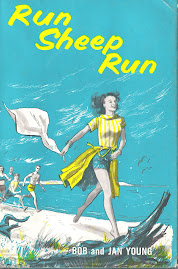
Well! Famous in New Hampshire! (At least among the shrinking number of people who still read newspapers.) Anyway, I think the universe is playing games with me. Because this weekend I was reading Sunday Dreamer by Bob and Jan Young, and in the middle of the book this fell out:


Could it be that for someone out there a grade school student ticket to a Mary College Marauders athletic event from 1970-71 has untold significance! I must find them! To the Google!