It's all about...popular girls...rec rooms...summers at the lake...dates with wealthy, thrill-crazy boys...black-market antiques...small town political corruption...and finding your true path in life. The Paris Hat considers the sometimes frothy, sometimes serious world of novels for teenage girls from the 1950s and 60s.
Showing posts with label Class divisions. Show all posts

Monday, April 11, 2011

Summer on Nantucket

Title: Six on Easy Street
Author: Betty Cavanna
Publisher: Westminster Press, 1954
Setting: Nantucket
Provenance: formerly the property of Chillicothe High School, Chillicothe, Missouri
Fun: running a boarding house, a French exchange student; finding an old diary
Quote: The house on Easy Street was square, and its shingles were weathered to a soft, dove-colored gray. The door was not in the middle, being flanked by a single window on one side and two on the other. The chimney too was a little off center, but the widow's walk, overlooking the harbor, was planted midway on the backbone of the steep-pitched roof.

Unlike some of Cavanna's other books, Six on Easy Street focuses on an entire family. The Sanfords, academics, have inherited a house in Nantucket and intend to open it to boarders for the summer, hoping to increase the family income. What follows is an exploration, by the entire family, of Nantucket: the whaling museum, bicycle rides, beach parties. There are guests to serve, including penny-pinching old ladies who don't tip, and boys, including a homely French exchange student and a cute grocery delivery boy.

The main female character, 16 year old Deborah, resents Nantucket, since it keeps her from Craig, her hometown boyfriend, who has invited her to visit him at his summer place. Deborah does have Carol, her best friend, on Nantucket with her, however. Carol's parents are divorced, and (as divorced parents always are in this era) wealthy and inattentive. The girls have contrasting views of their own families, and what they want out of life: Deborah thinks Carol's father's friends are grand and exciting, and Carol thinks that Deborah's parents have interesting dinner conversations.

Six on Easy Street is mostly fun. All the kids have adventures, including Johnny, the show-off younger brother, who runs away to find his cat. The history of Nantucket -- including the fate of the Essex -- is mixed in easily with the plot. In the end, Deborah, who has saved all summer to be able to go to Craig, gives the money to her family to pay the medical bills after her brother has a sailing accident, and is rewarded when Craig makes a surprise. Good thing she didn't fall in love with the homely French exchange student.

Monday, June 28, 2010

Little Monsters

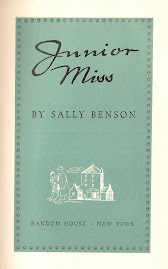
Title: Junior Miss
Author: Sally Benson
Publisher: Random House, 1941
Setting: New Yorker-land
Provenance: formerly the property of Marjorie Tremblay, a present from Cousin Albert, 1941
Fun: playing "Stepano, a drunken butler" in The Tempest; lily of the valley perfume; Pink Beauty, a (dead) trained mouse
Quote: "Look, Fuffy!" Judy exclaimed, "There's George Wade's house. Did you ever see anything like it? They haven't got a furnace or anything and they live there all winter. They throw their cans in the front yard. We can come down and get some if we want them for anything."
"They have lice," Lois said.

I bought the cheapest, most smudged copy available on Ebay and got a reward.
Sally Benson wrote the stories that were turned into the movie Meet Me In St. Louis. Those stories were originally published in the New Yorker, as were the Junior Miss stories. (Junior Miss was turned into a Broadway play which ran for two years and had a subsequent life as a movie, radio series and tv show.*) All this would lead one to believe that Junior Miss will be winsome and cheerful and all about the magic of being a young lady. This illusion is destroyed 4 pages in:

[Judy] was tall for her twelve years and heavily built. From her shoulders to her knees she was entirely shapeless, which gave her a square, broad look in spite of her height. Her summer tan had faded and her face had rather a ghastly yellow tinge. Below her skirt, which was too short for her, her legs were hard, muscular and covered with scratches. Her dress, a soft blue one, smocked at the sleeves, was supposed to hang gracefully...but instead looked as though she had been stuffed into it. She wore two rings on her fingers -- an aquamarine and a turquoise in gold settings. She had outgrown them and they drew her fingers in at their bases and made them look like sausages. She wore two charm bracelets of a brassy color and a locket and chain fastened so tightly around her neck it seemed it might throttle her. In the locket was a rather dim snapshot of a kitten and a clear picture of Tyrone Power. Her dark brown hair hung straight below her ears and was held in place by numerous bobbie pins and two ready-made bows. Her toenails, under her wool socks and scuffed brown oxfords, were painted with a decadent pink mother-of-pearl polish.
She sucked in her stomach, held her breath, and pulled her dress in at the waist. And, while the change in her silhouette reflected in the mirror was almost imperceptible, her eyes shone with a terrible optimism.

The reader is not being invited to identify with Judy, but to scrutinize her, and to discover that she's fat, vain and sentimental about kittens. This, I think, puts Junior Miss outside the realm of teen novels, one of the basic concepts of which is self-identification on the part of the reader. Junior Miss' origin in the New Yorker would seem to support this, but I can't for the life of me figure out whom the book was written for. Judy and her sister Lois think about little but nail polish, facials, beauty tips from magazines, and growing up as quickly as possible so they can wear stockings, perfume and "perfectly stunning" cruise clothes. Some writers can make this sort of thing charming, but Benson keeps sticking the knife in. The reader is made aware not just that these obsessions are frivolous but that they are complete failures. There's a moment in each story when one of the characters -- usually one of the parents -- will glance obliquely at the futility of life in general, and then smooth everything over and move on. Did sophisticated New Yorker readers in 1940 find this soothing? Did they think Judy and Lois amusing creations just like their own daughters? Did the irritatingly mournful comedy of the stories make them chuckle? I can't really answer that, any more than I can decide if this is a book you're supposed to enjoy or one to send a chill up your spine.


*Per Wikipedia, Junior Mints candy, introduced in 1949, was a play on "Junior Miss," which was still going strong on the radio at the time.

Thursday, April 1, 2010

The Right Sort

Titles: Then Came November; When Debbie Dared
Authors: Nan Gilbert; Kathleen Robinson
Publisher: Whitman, 1963
Cover art: Olindo Giancomini; Jim Tadych
Settings: Fairhills, a small town turned suburb; Karidale, a suburb of St. Louis
Provenance: "Helen Snyder" written inside front cover, raised seal on first page "Library of Ernestine L. Snyder."
Fun: homegrown watercress, fear of heights, going deeply into debt for the perfect coat.
Quote: "This is authentic Fraser plaid, woven in Scotland especially for our clan. I believe the firm now offers it for general sale, if your mother is interested in ordering, but whether they maintained the quality of the wool, I couldn't say--" (Then Came November)
"[Merry] was the only girl in Karidale to have ridden to hounds." (When Debbie Dared)

This was an era when class struck terror into the hearts of millions. In book after book, heroines are acutely aware of their social position, marked by such things as Chinese salad bowls, pedigreed dogs, and where they summer, as well as proximity to horses and booze.
In these two Whitman teen novels, Then Came November, and When Debbie Dared, Dulcy Rolff and Debbie Robyne both run up against snaky girls who, while pretending to be their friends, are secretly snobs. In Dulcy's case the motivation is Dulcy's superior social position. Dulcy is not wealthy, but her family bears a pioneer name in the town and gets frequent mention in the society column. As Elaine, the snake, puts it:

"Rolffs don't have to be rich. They don't have to butter people up and pull strings and -- don't you think I get sick, sick of watching Mother do it, every new town we go to?"

Dulcy, previously shy, and not blessed with a lot of foresight (she nearly kills her dog by giving him sleeping pills so he won't bark when she sneaks out) is completely suckered by Elaine, who shows her how to open a charge account ("just give them your father's name") and then, when she is in trouble at home and school, steals her boyfriend.

Debbie, on the other hand, is an ordinary soul taken up by Carlotta, a "New York girl" whose father has been transferred to Debbie's hometown. " 'Personally,' " Carlotta says, "with a twist of golden bare shoulders, 'I think it's gauche to dine early.' " Fortunately, Carlotta mispronounces gauche, and Debbie becomes disillusioned with her. Carlotta is also driven to a jealous fit when another senior girl drops out to marry her fiance, a West Point cadet. (The lucky thing -- she gets to start her married life on an army base in West Germany!) It turns out that she only cultivated Debbie to get her help on her French homework. Carlotta ends up alone and unloved, while Debbie rides the ferris wheel at the state fair with her new boyfriend -- the son of an orthopedic surgeon.
While it might seem that the common folks prevail, in fact neither Dulcy nor Debbie questions that there are certain things one ought to have or aspire to. When Debbie looks over her mother's dinner table before a party, she sees her grandmother's silver candlesticks, Calyx dinner ware, a linen tablecloth and "unmatched flat silver, all old and much of it worn thin." Dulcy, for her part, is comforted by her family's loyalty to anyone in trouble.
As for poor familyless Elaine, she and her Mother will evidently have to once again move to a new town and start pushing their way in among the right people.

Friday, March 5, 2010

Regionalism

Title: The Hundred Steps
Author: Holly Wilson
Jacket Artist: Albert Orbaan
Publisher: Julian Messner, 1958
Setting: "Clifton" (Marquette), Michigan
Provenance: Unknown
Fun: Pyromania; sea chanteys; berry-picking interrupted by a bear
Quote: "Flannelmouth!" said Susan, and she went off into a burst of giggles that infected the group around her. They laughed heartily and slapped each other on the back, repeating, "Flannelmouth! You're all a bunch of flannelmouths!"

One of the nice things about many of these 1960s teen novels is that instead of being set in the bland suburbia we associate with that era, they are actually grounded in specific places -- like the California desert town of One Small Voice -- and so draw a nicely detailed picture of particular American regions. The Hundred Steps is dominated from page one by its setting in Clifton (evidently based on Marquette), Michigan. The steps of the title lead from the Lower Town, home of the fisherfolk, to the Upper Town, home of the iron ore millionaires. Marcy McKay lives in the Lower Town, naturally, and her father works on an ore carrier, shipping cargo across Lake Superior. The lake is as important as any other character in the book, and the climax of the novel is a shipwreck and rescue in Clifton Harbor. This event brings together the Upper and Lower Towns and smooths out the class divisions that form the major theme of The Hundred Steps. Marcy has begun hanging out with Upper Town girls, although she's not sure they really accept her. The Upper Town is epitomized by wealthy pyromaniac Walt Hamilton*, who tops off a date with Marcy by setting fire to the town's ski slide. The police investigation of this provides the drama of the first part of the book, though the eventual court case is anti-climactic. Then, after a couple of filler chapters, a big storm blows through, Marcy's father's ship runs aground and Walt proves a decent person after all. (Walt is not actually the hero of the novel, safe and less interesting Bill Carlson is.) And if you don't want to go on vacation to the Upper Peninsula of Michigan after reading this novel, something is wrong with you.


*Walt seems to be the name of choice for male characters. Other books with Walts: One Small Voice, The Paris Hat. Perhaps it was the Disney influence?

Tuesday, February 23, 2010

Stay Away from Boys Who Like Wagner

Title: I, Judy
Author: Eve Bennett
Publisher: Julian Messner, 1957
Setting: Outdoorsy Denver
Fun: Aspen before the celebrities ruined it; singing folk songs; dressing up as the Unsinkable Molly Brown
Quote:
"Ever since she had been a bit of a girl and had dreamed up stories and believed in fairies, and had read every moment she was allowed, Judy had meant to be a writer."

A lot of teen novels don't deal very directly with romance. Sure, there's a steady boy somewhere in a background subplot, but he's the kind of boy only a matronly novelist would designate as the hero -- handsome but not arrogant about it, even-tempered, full of common sense and possessed of a one-syllable name like Bill, Joe or Walt. Of course there's a very good reason for keeping boys out of books that are mainly designed to help girls sort out growing up. Boys are a distraction. They lead to bad decision-making. Therefore the easiest hero to have is an understanding one who stays entirely in the background except for the moment he asks the heroine to the Spring Formal.

Give some credit, then, to I, Judy, for focusing a plot on what to do when you have a bad boyfriend. Judy is an unusual heroine -- skinny and neurotic. She's a latchkey kid (her father's dead and her mother supports the family) who in the first chapter is elected to the school newspaper and receives a poison pen letter insulting her sloppy appearance. On a trip to Aspen as a reporter she meets Riley, a passive-aggressive rich kid. Danger appears when Riley invites her to his house when his parents aren't home and plays his favorite classical records, all of which, Judy notes, seem to have the word "death" in the title. Riley tells her listening to them makes him feel:

"As if I'm standing apart, 'way above everything. As though I can see clearly all the little things, the little people. I'm above them and they don't matter. I'm sorry for them and their little crawling insignificant lives -- but they don't really matter. There are the stars and the sun and the moon and storms all about me -- the lightning and the thunder and all the elements -- I love it! I feel like God!"

At which point Judy suddenly remembers she has some homework she's forgotten to do.

Judy finds her voice writing for the school paper, makes some more friends and begins to see her mother as a human being, but through it all Riley hangs around, throwing tantrums, not calling and playing the neglected-rich-kid card at every opportunity. Judy doesn't quite get rid of him because she recognizes that she shares some of his emotional peculiarities. However, because this is a teen novel, I, Judy does not end with a double suicide to the strains of Die Walkure. Instead a deus ex machina sends Riley to military school. (Love of Wagner plus military school. Great combination.) With him goes the last touch of realism in the novel, for in the final chapter Judy is awarded a college scholarship, gets a part-time job writing for an actual newspaper and has at least two potential new boyfriends, one of whom says "It's OK if you can't cook, because I can."
I suppose it's unfair to quibble about the happy ending. Judy sort of deserves it, after Riley. And I, Judy does a good job of walking that line between benign entertainment and something a little deeper.

Friday, February 5, 2010

Don't Mess With Candy

Title: Say Hello, Candy
Author: Bianca Bradbury
Publisher: Coward McCann, 1961
Jacket Artist: Paul Frame
Setting: Carlisle, Maine
Provenance: Formerly the propery of the Jessie E. McCuffy Memorial Library, Dixon, Missouri
Fun: sulky teens; fake antiques; summer people vs. townies

Quote: "You've changed, Funny-face. Do you know that?"
"How?" she asked.
"You're still as gorgeous as ever. I think you're the best-looking female woman I know. But you're more serious. I don't know, I look at you and I think, wheels are turning inside her head. You never used to have wheels inside your head. You were just my girl, an awful sweet, empty-headed doll."

The jacket illustration is striking, isn't it? I have it on my Flickr photostream and it gets far more hits than the other illustrations in the set. Although something about Candy's hair irritates me every time I look at it.

Say Hello, Candy starts with a serious situation. Candy Andrews' father has been paralyzed in a car accident. In 1961 this relegates him to the status of a cripple -- unable to go back to work or even navigate much of the outside world (in one scene he has to eat in his hotel room because the restaurant can't accomodate him.) Nevertheless, as a parental figure in a teen novel, he is not bitter. Since their income is gone, Candy's family moves from the pleasant suburbs of Long Island to Carlisle, Maine, her father's hometown, where they had formerly summered. They hope to settle in as permanent residents, with Candy's mother supporting the family by selling antiques. The drama of the book is provided by Candy's slow adjustment to this disaster. She knows she ought to be cheerful and helpful to her mother, but she just can't force herself to feel grateful and count her blessings:

Older people think that if they can put things in words then that takes care of everything. Her parents acted as though they were resigned to any blows fate handed out to them. I'm not going to give in, she thought, lying stiff and rebellious. I'm not going to sit around waiting for the night to come so the day will end. I'm going to fight! My life's not over!

Carlisle is so remote it doesn't even have television, and the only people Candy knows there are the "summer people." The story progresses in an episodic fashion. Candy helps her mother stock the antique store and then works behind the counter, sometimes enjoying it and sometimes resenting it. She has a confusing number of romantic encounters with both town and summer boys, all of whom seem to surface and vanish without much significance. She almost cheats a woman who buys a fake antique chest, but at the last moment feels remorse. She quarrels with her mother and makes up. Even on page 175, Candy is still whispering "I hate them, I hate them" as the summer people drive by in their cars, laughing carelessly (is there any other way to laugh?) And then miraculously, in the next and last chapter, she's fully accepted life in Carlisle and steady friendship/romance with a town boy.
Never mind the ending. The most powerful part of Say Hello, Candy, is Candy's discontent, a lightning rod that runs through the book, dominating it as she dominates the cover.