It's all about...popular girls...rec rooms...summers at the lake...dates with wealthy, thrill-crazy boys...black-market antiques...small town political corruption...and finding your true path in life. The Paris Hat considers the sometimes frothy, sometimes serious world of novels for teenage girls from the 1950s and 60s.
Showing posts with label Career Romances. Show all posts

Thursday, July 7, 2011

...After They've Seen Par-ee?

Title: Princess in Denim
Author: Zoa Sherburne
Publisher: William Morrow, 1958
Provenance: ILL, currently the property of the Wichita State University Library
Setting: Rural Washington State
Fun: Miss Tulip contest; owning your own horse; the wiles of the big city

Zoa Sherburne is best remembered for Why Have the Birds Stopped Singing? a 1974 novel about epilepsy and time travel. To my mind, she's one of those writers who came into their own in the 1960s and 70s, when subject matter shifted and broadened. (Too Bad About the Haines Girl (1967) was a groundbreaking "problem novel" about teen pregnancy.) Sherburne began publishing in the mid-fifties, however, and her earlier novels, while lighter in tone, are never silly and take pains to present realistic, if not terribly dramatic, dilemmas for her characters.

Eden lives in a small town in Washington State, where her father is a farmer. She allows her would-be boyfriend, Steve, to take a picture of her as a farmgirl -- blue jeans, straw hat -- which he then enters in a local beauty contest. Struck by something refreshing in the shot, the judges award Eden the title of Miss Tulip.

Up to this point, Eden has been happy with her life, with little interest in glamor. But news of her win brings to town a charming newspaperman, Johnny Halloran. He offers to manage her in the Miss Washington contest, perhaps even taking her all the way to Miss America. It's one of Princess in Denim's strengths that the reader believes in Eden's fascination with Johnny and all he promises. Eden is content with her life, but, naturally enough, she wonders if there could be more out there than she knows about. And, naturally enough, she doesn't want to turn her back on it before she finds out. And so Eden, over the protests and guarded warnings of Steve, her father and several other adults, goes to Seattle under Johnny Halloran's wing.

It's not difficult to guess that Eden is eventually going to choose to return to life on the farm. But Sherburne manages it so that this choice does not seemed forced or leave the reader with sense of disappointment. One of the reasons for this is that the farm Eden comes back to is not the one she left; the life she resumes has undergone some major changes. Princess in Denim is not the most exciting novel Sherburne wrote, but Eden is a winning heroine of a worthy story.

Sunday, August 8, 2010

In the Garden

Title: The Organdy Cupcakes
Author: Mary Stolz
Publisher: Harper & Row, 1951
Setting: Pre "Jersey-Shore" New Jersey
Provenance: formerly the property of the Butler Country Traveling Library
Fun: psychoanalysis; hats in the icebox; the daily drama of life and death.
Quote: "It was not an unfamiliar feeling, this one, for Gretchen had been more or less falling in love since she'd been fourteen. But not like this, she thought. Nothing like this at all."

The title and cover make more sense when you learn this book was later republished as Student Nurse.
The Organdy Cupcakes
takes us back to the days when nurses wore little paper caps, lived in residential dormatories with a matron, and dreamed of marrying doctors. Of the three girls -- Gretchen, Nelle and Rosemary -- only Gretchen achieves this, somewhat suddenly, at the very end of the book. Nelle marries a wealthy dilettante obsessed with Ancient Egypt (they don't make 'em like that anymore) while Rosemary dumps her doctor-boyfriend to join the Army nursing corps. (This is probably a wise move, since he has just psychoanalyzed her, which is a poor foundation for any marriage.)
Mary Stolz had a remarkable career, publishing her first YA novel in 1950 and her last in 1988, and negotiating the era of "serious topics" for young adult novels with some ease. She won Newbery Honors in 1966 for The Noonday Friends, which is the title that most rings a bell for someone of my generation. Style-wise, Stolz's novels are lush and dreamy, full of gardens and rain and glittering sunshine as the characters muse about their lives. As a child I found this kind of thing hard to follow, which is probably why I can't recall anything of The Noonday Friends now except the title. But as an adult I found The Organdy Cupcakes a beautiful book to read, particularly for its peaceful setting in small-town New Jersey before it became suburbanized. The details of hospital life are so well drawn that it's hard to believe that Stolz never trained as a nurse. (Stolz did suffer from severe arthritis in the 50s, so perhaps she drew her insights as a patient.) There aren't a lot of serpents in Stolz's gardens, but it's nice to see her characters moving into the adult world, knowing what they want for themselves.

Wednesday, July 21, 2010

The First Time

Title: The Tender Time
Author: Denise Cass Brookman
Jacket: Stanley Dersh
Publisher: Macrae Smith, 1958
Setting: An unnamed state where it gets down to -14 in the winter.
Fun: Coke dates; wearing his ring; ennui; a slimy best friend
Quote: "I hope..." her mother began, and began again, "I hope...that's not starting all over again."
"That," Stephanie said, putting on fresh lipstick, "can start only once."
"Don't be flippant, Stephie!" Then, anxiously, "It's over, isn't it?"
Stephie smiled at her mother in the mirror. "Finished. Not over." She turned around and kissed her lightly on the cheek. "There's a difference."

The main business of most teen novels is less romance than personal growth -- learning to ice skate, or that being popular isn't as important as being yourself, or that rich snobs ought to go back to New York City where they belong. Boys are dwelt on and sometimes chased after, but they aren't taken very seriously and are rarely allowed to clutter up the plot.

Not so The Tender Time, which looks squarely and unashamedly at romance in all its phases, from miracle of the first date to the glory of going steady to -- alas! -- the all-too-common sequel of terminal boredom:

"She tried to remind herself that though the old exhilaration was gone, so was the old depression and no-middle feeling. And simply because the exhilaration was gone didn't mean that love was, too. It really was much saner this way, she reassured herself. And yet..."

Brookman maintains a light tone but she misses very little. Scott, Stephie's boyfriend, is an egomaniac who refuses to believe a girl would actually break up with him. Stephie is so gullible she doesn't see her best friend is out to steal Scott. None of this is a tragedy, for Brookman, in spite of the title, isn't trying to write about true love. She's writing about that first high school relationship.

And in the oddly philosophical ending to the book, Stephie reminds her mother that though her relationship with Scott is over, it will never really end, because she can never fall in love with anyone else that way again:

"And that's how it didn't end...Always to be remembered, nothing ever to be remembered quite like that. No matter how many times the same things are done...Never the same as the first time, the young time, the tender time."

Monday, June 21, 2010

Beyond the Dream

Title: Follow Your Dream
Author: Marjorie Holmes
Cover Art: James Talone
Publisher: Westminster Press, 1961
Setting: Hometown Washington, DC
Fun: Hamsters in the refrigerator; Georgetown grande dames; a crazy cat lady
Quote: "Beside her, holding a monkey, stood the tallest, handsomest and quite the most terrifying man Tracey had ever seen."

The authors of many of these novels, most of whom, according to the jacket blurbs, were the mothers of teenagers themselves, seemed to know very well that marriage did not preclude a career. In fact, in book after book, they are fully in sympathy with girls who want to do something or make something of themselves. Follow Your Dream is a textbook example of this -- there is never any doubt that Tracey will become a veterinarian. The twist is that Tracey wants a man as well.

We first meet Tracey Temple when she is being told, by a school Career Day speaker, that women can't be veterinarians. Tracey proceeds to heckle him, and is reprimanded by the principal. Being a vet is not just her dream, but her destiny, and when school ends, she is thrilled to get a summer job with Dr. Jane Baldwin, Washington D.C.'s only female vet. On the first day there, however, she falls in love with Whit, a third-year vet student. Whit, as it turns out, is in love with Diana, another student. And then there's Jeff, Tracey's old flame, who also falls for Diana, and good old Dudley, the boy next door. In short, it's a full-fledged love...well, pentagon, which winds through the story and pushes the animal-hospital vignettes into the background.

Tracey is a strong characters and Follow Your Dream never for a moment suggests she would be happier getting married and settling down. But what Tracey wants is Whit and a career, and what Follow Your Dream does suggest is that Tracey will never get both. Whit goes off to finish his education at the end of the book, hinting that Tracey ought to "stop knocking herself out over the wrong things. The things that were never meant for you." And Follow Your Dream leaves it at that. There is a future for Tracey, but, as with any of us, it may not be the one we anticipate.

Friday, April 23, 2010

Behind the Scenes at the Card Shop

Title: A Valentine for Vinnie
Author: Marjory Hall
Publisher: Funk & Wagnalls, 1965
Cover art: unknown
Setting: a unnamed state with fogs, long winters and towns with names like Rock Harbor and Pine Bay
Provenance: formerly the property of the West Bend Public Library
Fun: inside knowledge of the retail card biz; college weekends; queer old maids
Quote: "Halloween!" she said aloud. "Who ever heard of a such a thing? I never sent a Halloween card, and I never got one either."

Vinnie works in a card shop. After a slow beginning, she discovers that she likes the card shop. She has ideas about the card shop. A new window display, for instance, and better inventory procedures. And the aforementioned Halloween cards. Then there's the good looking salesman (alas, married) who stops by and befriends her. And Ted -- her crush since high school, who comes in to buy a card as well.

Marjory Hall began her writing career in the 1940s, with maltshop romances, and A Valentine for Vinnie seems closer to that era, and genre, than its 1965 publication date would indicate. There is a college weekend -- driving up to meet a date for the big game and a dance -- and a subplot about building the new country club. Vinnie, though not terribly insightful, is pure-hearted and hopeful. But maybe Hall was, by 1965, a little tired. Certainly by about half-way through Valentine she has lost interest in Vinnie. You hear less about the card shop, and more about new characters. And then Ted invites Vinnie to a college dance, and, the day before the dance, uninvites her -- not even in person, but by letter. This could have been the book's emotional core. Instead, Vinnie just has a good cry and decides it's all for the best:

"Her great devotion to Ted had put blinders on her. She hadn't enjoyed the good things, or the right people, all this time. Hal, for example."

Exactly 22 pages later Hal is giving her his pin.

Thursday, January 7, 2010

The Career Romance

Title: The Paris Hat
Author: Mary Cunningham aka Mary Pierce Cunningham.
Publisher: Funk and Wagnalls, 1958
Setting: Bucolic San Francisco
Provenance: "Pat Arnold" inside front cover
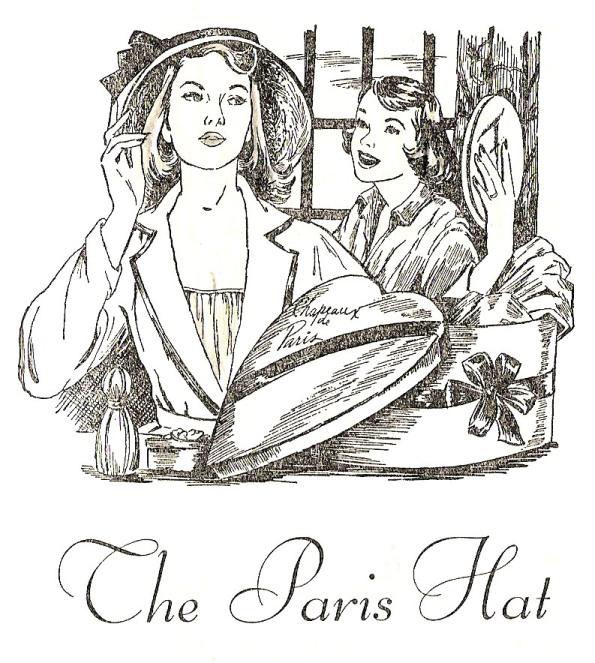
Fun: "You see," she explained,"his real love is dressage."; making marzipan out of prune pits; Mysterious Footprints in the Bushes; a big heart-shaped hatbox labeled Chapeaux de Paris.
Quote: "Gerry sat down with a plunk and twiddled her thumbs in mock gravity. "I am a lady," she said demurely. "If you don't believe it, just look in my top drawer and you'll see three and a half pairs of the purest white gloves a lady ever -- "

Apparently there was a recognized genre in the 1950s publishing trade called "career romance." Basically, the heroine was going to choose between a man and a career. The Paris Hat is right square in the middle of this genre. In fact, everyone in The Paris Hat, male and female, is on the horns of some decision about what they really want out of life. The central character is 17-year-old Cathy, lifelong big sister to a mess of motherless children, who has been invited by handsome Rex to be his ballet partner. The other member of the triangle is boy-next-door Walt, who invents things in his spare time and likes fishin'. In the background, Aunt Faith dithers over the Paris hatbox, symbol of the world she has turned her back on when she let her husband go on a two-year business trip to Africa alone. (What business is there in Africa? Sparkling, uncorrupted, blood-free diamonds. A girl's best friend.) And there's Aunt Gerry, an artist who works happily at an ad agency, has plenty of dates and has no wish to get married anytime soon. And finally, there's Rick, with his aforementioned love of dressage, who must work in a bank. There is much discussion of what makes people really happy and general agreement that there are no easy answers. Cathy meets Rachel, Rex's married sister, who says, "If only I could stop being a mother for just a week. Or maybe for just three days." [I will repeat -- this novel was written in 1958. Yes, that 1958.] On page 180, having realized that she is probably not talented enough to be a professional ballerina, Cathy accepts the offer of a job teaching dance to children while continuing her studies. And walks home with Walt, who hopes she'll come over to the workshop if she has a minute.
The Paris Hat is the kind of book where everyone has a housekeeper and there's a grandmother who says "Land's sakes!" But it's a little more than that. All of the characters have a realistic edge and certain liveliness. Consider Grandma:

Grandma was in bed with a book. She always said that she was so old that if she wanted to read in bed around the clock, she guessed she could without her family saying boo.

I'd be willing to be that some of them were based, at least a little, on the writer's family. There's that kind of cosiness to The Paris Hat. And the basic theme of this old-fashioned career romance is that the right choice for you is the one that makes you happy.