It's all about...popular girls...rec rooms...summers at the lake...dates with wealthy, thrill-crazy boys...black-market antiques...small town political corruption...and finding your true path in life. The Paris Hat considers the sometimes frothy, sometimes serious world of novels for teenage girls from the 1950s and 60s.
Showing posts with label Bob and Jan Young. Show all posts

Thursday, October 21, 2010

West Coast Story

Title: Sunday Dreamer
Authors: Bob and Jan Young
Publisher: Julian Messner, 1962
Setting: Seaside Cordoba, California
Provenance: unknown, but sometime around 1971 was owned by someone who lived in Bismarck, North Dakota
Fun: Grandma vs. the zoning board; school rivalry; vandalism
Quote: "For years we've prided ourselves that Cordoba didn't have a juvenile delinquency problem but this situation between the high schools is getting out of hand. It's beginning to look more and more like some of that outright gang warfare you hear about in the big cities."

Do people still write books about girls who just want to be popular? How exactly did it come about that popularity became synonymous with evil and the popular girl a cardboard character who represented every negative value? As I remember high school the popular girls were flimsy, airheaded creatures who didn't bother much with girls like me (something I didn't resent) and who hardly had the impetus or time to go around destroying the lives of lesser mortals, or even saying nasty things to them. High school wasn't war, high school was indifference -- which can actually be much, much worse.
In books from this era, however, popularity is rarely portrayed as a negative thing. Every heroine wants to have lots of friends and be among the class leaders, all of whom are nice, normal girls. True, the occasional cat shows up in their ranks, but her sharp tongue usually causes her downfall before long. After all, who would want to be friends with someone who isn't nice?
So this brings us to Sunday Dreamer. Moving to Southern California from San Francisco, where she had one friend at school, is a fresh start for Nancy. Her grandmother's social position as foundress of the town ought to help, too. But Nancy tries too hard, she's too studied in her "witty" responses to friendly questions, she takes offense too quickly, and before you know it she's eating lunch all by herself in Cordoba, too.
Given that being popular is synonymous with being normal, no-one questions that Nancy is right in wanting it. She just has to go slow, and since this book is by the Youngs, Nancy's journey will involve something serious and thought-provoking. In this case, nursing. Nancy volunteers at the hospital, she brings in other girls to help, she unites two feuding high school gangs, and she pulls an all-nighter after a train accident. After all that, who the hell cares about being popular?

And thanks to Carole Anne Carr, who gave me a Literacy Builder Award this week. I posted my five favorite words and passed it on to three other bloggers on my other blog, Pray for Rain. Thanks again, Carole Anne.

Tuesday, March 16, 2010

From Surfer Girl to Science Nerd

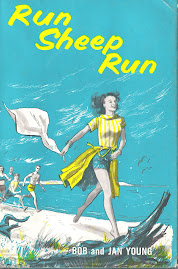
Title: Run, Sheep, Run
Authors:
Bob and Jan Young
Jacket illustration: Jon Nielsen
Publisher: Julian Messner, 1959
Setting: The coast of California
Fun: hoodlums on motorcycles; paying for college by selling smoked fish; up close and personal with sea anemones
Quote: Sue had warned the idea would be startling, but Judy was hardly prepared for that murmur of surprised voices. "A party?" Derek looked flabbergasted, "But the Science Society never has parties."

The Youngs often picked important topics for their books -- political corruption in One Small Voice, prejudice against Hispanics in Across the Tracks. Run, Sheep, Run's topic is the social prison that is high school, or, how "society's demands for conformity often crushes the individual's courage."

Judy Cannon starts out as a member of a crowd of young people who hang out on the beach all summer and who consider anyone who gets good grades an "apple-polisher" and teacher's pet. Judy's first error is taking biology and liking it. Then, in a mild setback to her social life, her mother gets sick (the doctor doesn't say exactly what she has, but it has something to do with her working in an underground bank vault all day) and the family moves to a house on an isolated point, the better for sea air and sun. Judy becomes fascinated by tide pools, helps out with her family bait business and, the final straw for her friends, joins the Science Club.
It turns out, however, that the Science Club members are just as set in their ways as her former friends. Tall, blond Derek, who had seemed so friendly on that field trip to the marine biology lab, now tells Judy, "the student who is seriously interested in science hasn't time for other interests." Hmm. Were this a B-movie, Derek would end up rescuing Judy from a Giant Crab Monster and would indeed discover that he has other interests. Instead, Derek skulks off, aloof scientist to the end, and Judy's old crowd gradually comes back into the picture. They've grown, too, and they kind of admire Judy's independence.
Is it a little odd to write about social conformity by setting a novel amid bait shacks and marine biology labs? Yes, but it's the kind of thing the Youngs were good at. There's something grandly optimistic about Run, Sheep,Run, and like One Small Voice, it belongs very much to its time. I sometimes wonder if along about 1970 or so the Youngs weren't wishing they could put the non-conformity genie back in the bottle.

Wednesday, January 20, 2010

The Mayberry Underground

Title: One Small Voice
Authors: Bob and Jan Young
Publisher:
Julian Messner, 1961
Cover Art: Georgeann Helms
Setting: Granada, a small California town
Provenance: Formerly the property of the Western Kentucky University library
Fun: High school production of HMS Pinafore; fiery Iron Curtain refugee; protest march stopped by the cops; bribery, corruption, intimidation and voter apathy.

Quote: "It seems to us there are a lot of people who don't show any interest in local politics," Walt observed.
"I suppose there are a few," Mayor Keally admitted, "but then people are busy. It appears to me that's a sign of a good administration. There's no need for busy people to vote when they know their city is in good hands, now is there?"

"It is our hope that other young people reading this book will also discover that the study of American Government is not all dreary memorization, politics is not just a field for the isolated few -- but put into practice good citizenship can be a lively, exciting and rewarding experience" -- from the back cover of One Small Voice.

Bob and Jan Young co-wrote a number of popular teen novels which feature ordinary heroines involved in somewhat serious subjects. Reviewers of the day liked them. "In abandoning pat solutions and stereotypes they have sought truth in human reactions and situations, and the result is an inspiration to teenagers of both sections," -- so said Virginia Kirkus.* Their first novel, Across the Tracks, is about Hispanic/Anglo relations in a California town. One Small Voice, takes up, surprisingly enough, small-town political corruption. Gina Morgan goes out on an awkward date with Walt Kennedy. On the way home he hits a parked car. Parked car, which has a scratch on its fender, belongs to a cop, who says for $20 he'll forget the whole thing. When Walt refuses, the situation escalates, Walt is arrested and Walt's father ends up paying $30** to the police chief to forget the whole thing. Encountering apathy and "but-it's-always-been-this-way" among the adults, Walt, Gina and some other high school kids begin a civics project to encourage voter participation and end machine politics in their town. There are ups and downs, mixed in with tryouts for HMS Pinafore (Gina gets Hebe, not Josephine), some baking, having to go to the Spring Formal with sarcastic Tom Peebles, little sister's bicycle accident...but throughout it are some sinister undertones. The driver who hits little sister's bicycle is the brother in law of a cop, who drops by to hint at negligence and a frame-up. Gina's father's boss comes by, too, to hint that her father might lose his job if his daughter continues to stir things up. And their "get-out-the vote" march is abruptly canceled for lack of a permit. But everyone, good guys and bad, keeps their heads in the end, and the election not only has a record voter turn out but results in some (limited) political change, which Gina reasons is about as much as might be expected.

One Small Voice is not completely a civics text, however. Gina's relationship with Walt builds from its bad start into steady dating and her role in Pinafore brings her into the current of high school affairs and gives her confidence. Also, like The Charmed Circle, One Small Voice has a character who is a refugee from the Iron Curtain -- Paul Marchek, a "tall, good-looking Hungarian boy." Paul is there partly to remind everyone of the importance of freedom, but he's also a realistic character, given to losing his temper and making fiery suggestions. ("Let's start an underground movement!") Paul is a reminder that One Small Voice is balanced, in a very prescient way, squarely between the previous decade and the oncoming one. It captures the we're-going-to-change-things feeling of Gina's generation (I can just picture Paul, at any rate, sitting-in at Berkeley) while keeping its feet firmly in Americanism, citizenship and democracy:

Only someone who was very frightened, like Mayor Keally, had to resort to dirty politics. Next Tuesday everyone would have a chance to show his personal feelings at the polls.


*Founder of the Kirkus Reviews and the children's book reviewer of her era.
**More money than it sounds. Gas in 1961 was 30 cents a gallon and you could get a burger in a fast-food restaurant for 15 cents. Another good measurement might be that in Run, Sheep, Run the heroine contemplates spending $35 on a formal dress.