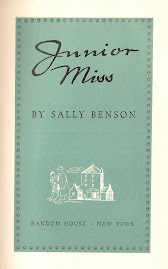
 Title: Junior Miss
Author: Sally Benson
Publisher: Random House, 1941
Setting: New Yorker-land
Provenance: formerly the property of Marjorie Tremblay, a present from Cousin Albert, 1941
Fun: playing "Stepano, a drunken butler" in The Tempest; lily of the valley perfume; Pink Beauty, a (dead) trained mouse
Quote: "Look, Fuffy!" Judy exclaimed, "There's George Wade's house. Did you ever see anything like it? They haven't got a furnace or anything and they live there all winter. They throw their cans in the front yard. We can come down and get some if we want them for anything."
"They have lice," Lois said.
I bought the cheapest, most smudged copy available on Ebay and got a reward.
Sally Benson wrote the stories that were turned into the movie Meet Me In St. Louis. Those stories were originally published in the New Yorker, as were the Junior Miss stories. (Junior Miss was turned into a Broadway play which ran for two years and had a subsequent life as a movie, radio series and tv show.*) All this would lead one to believe that Junior Miss will be winsome and cheerful and all about the magic of being a young lady. This illusion is destroyed 4 pages in:
[Judy] was tall for her twelve years and heavily built. From her shoulders to her knees she was entirely shapeless, which gave her a square, broad look in spite of her height. Her summer tan had faded and her face had rather a ghastly yellow tinge. Below her skirt, which was too short for her, her legs were hard, muscular and covered with scratches. Her dress, a soft blue one, smocked at the sleeves, was supposed to hang gracefully...but instead looked as though she had been stuffed into it. She wore two rings on her fingers -- an aquamarine and a turquoise in gold settings. She had outgrown them and they drew her fingers in at their bases and made them look like sausages. She wore two charm bracelets of a brassy color and a locket and chain fastened so tightly around her neck it seemed it might throttle her. In the locket was a rather dim snapshot of a kitten and a clear picture of Tyrone Power. Her dark brown hair hung straight below her ears and was held in place by numerous bobbie pins and two ready-made bows. Her toenails, under her wool socks and scuffed brown oxfords, were painted with a decadent pink mother-of-pearl polish.
She sucked in her stomach, held her breath, and pulled her dress in at the waist. And, while the change in her silhouette reflected in the mirror was almost imperceptible, her eyes shone with a terrible optimism.
The reader is not being invited to identify with Judy, but to scrutinize her, and to discover that she's fat, vain and sentimental about kittens. This, I think, puts Junior Miss outside the realm of teen novels, one of the basic concepts of which is self-identification on the part of the reader. Junior Miss' origin in the New Yorker would seem to support this, but I can't for the life of me figure out whom the book was written for. Judy and her sister Lois think about little but nail polish, facials, beauty tips from magazines, and growing up as quickly as possible so they can wear stockings, perfume and "perfectly stunning" cruise clothes. Some writers can make this sort of thing charming, but Benson keeps sticking the knife in. The reader is made aware not just that these obsessions are frivolous but that they are complete failures. There's a moment in each story when one of the characters -- usually one of the parents -- will glance obliquely at the futility of life in general, and then smooth everything over and move on. Did sophisticated New Yorker readers in 1940 find this soothing? Did they think Judy and Lois amusing creations just like their own daughters? Did the irritatingly mournful comedy of the stories make them chuckle? I can't really answer that, any more than I can decide if this is a book you're supposed to enjoy or one to send a chill up your spine.
Publisher: Random House, 1941
Setting: New Yorker-land
Provenance: formerly the property of Marjorie Tremblay, a present from Cousin Albert, 1941
Fun: playing "Stepano, a drunken butler" in The Tempest; lily of the valley perfume; Pink Beauty, a (dead) trained mouse
Quote: "Look, Fuffy!" Judy exclaimed, "There's George Wade's house. Did you ever see anything like it? They haven't got a furnace or anything and they live there all winter. They throw their cans in the front yard. We can come down and get some if we want them for anything."
"They have lice," Lois said.
I bought the cheapest, most smudged copy available on Ebay and got a reward.
Sally Benson wrote the stories that were turned into the movie Meet Me In St. Louis. Those stories were originally published in the New Yorker, as were the Junior Miss stories. (Junior Miss was turned into a Broadway play which ran for two years and had a subsequent life as a movie, radio series and tv show.*) All this would lead one to believe that Junior Miss will be winsome and cheerful and all about the magic of being a young lady. This illusion is destroyed 4 pages in:
[Judy] was tall for her twelve years and heavily built. From her shoulders to her knees she was entirely shapeless, which gave her a square, broad look in spite of her height. Her summer tan had faded and her face had rather a ghastly yellow tinge. Below her skirt, which was too short for her, her legs were hard, muscular and covered with scratches. Her dress, a soft blue one, smocked at the sleeves, was supposed to hang gracefully...but instead looked as though she had been stuffed into it. She wore two rings on her fingers -- an aquamarine and a turquoise in gold settings. She had outgrown them and they drew her fingers in at their bases and made them look like sausages. She wore two charm bracelets of a brassy color and a locket and chain fastened so tightly around her neck it seemed it might throttle her. In the locket was a rather dim snapshot of a kitten and a clear picture of Tyrone Power. Her dark brown hair hung straight below her ears and was held in place by numerous bobbie pins and two ready-made bows. Her toenails, under her wool socks and scuffed brown oxfords, were painted with a decadent pink mother-of-pearl polish.
She sucked in her stomach, held her breath, and pulled her dress in at the waist. And, while the change in her silhouette reflected in the mirror was almost imperceptible, her eyes shone with a terrible optimism.
The reader is not being invited to identify with Judy, but to scrutinize her, and to discover that she's fat, vain and sentimental about kittens. This, I think, puts Junior Miss outside the realm of teen novels, one of the basic concepts of which is self-identification on the part of the reader. Junior Miss' origin in the New Yorker would seem to support this, but I can't for the life of me figure out whom the book was written for. Judy and her sister Lois think about little but nail polish, facials, beauty tips from magazines, and growing up as quickly as possible so they can wear stockings, perfume and "perfectly stunning" cruise clothes. Some writers can make this sort of thing charming, but Benson keeps sticking the knife in. The reader is made aware not just that these obsessions are frivolous but that they are complete failures. There's a moment in each story when one of the characters -- usually one of the parents -- will glance obliquely at the futility of life in general, and then smooth everything over and move on. Did sophisticated New Yorker readers in 1940 find this soothing? Did they think Judy and Lois amusing creations just like their own daughters? Did the irritatingly mournful comedy of the stories make them chuckle? I can't really answer that, any more than I can decide if this is a book you're supposed to enjoy or one to send a chill up your spine.
*Per Wikipedia, Junior Mints candy, introduced in 1949, was a play on "Junior Miss," which was still going strong on the radio at the time.