It's all about...popular girls...rec rooms...summers at the lake...dates with wealthy, thrill-crazy boys...black-market antiques...small town political corruption...and finding your true path in life. The Paris Hat considers the sometimes frothy, sometimes serious world of novels for teenage girls from the 1950s and 60s.

Thursday, August 26, 2010

Divided Loyalties

Titles: The Divided Heart; Honor Sands
Authors: Mina Lewiton; Mildred Lee
Publishers: E.M. Hale, 1947 (1965 reprint); Lothrop, Lee & Shepard, 1966
Provenance: Formerly the property of the Nye County (Nevada) School District
Settings: New York City; Cypress, a small Florida town
Fun: Playing "Greensleeves" on the harp; helping your old man out with a couple of extra bucks; characters named Princess Gault and Mr. Bubber Arrington
Quotes:
"I've been reading up on Child Psychology. What are you going to do, Julie?" "Do?" "For a career, I mean." (The Divided Heart)

I don't deserve Mother or Daddy -- or Grandma, either, Honor thought. I am an evil person. She cut the zinnias as long stemmed as possible. (Honor Sands)

Both these books belonged to the school district of Nye County, Nevada, probably to the school in Tonopah, the town where I bought them.* Both books still had their check-out cards in their back pockets, and I couldn't help peeking to see how popular they might have been. (A dangerous thing for a writer to do, I know.) Honor Sands was checked out a total of 6 times, most recently in October 1972. The Divided Heart, however, was checked out 24 times, mainly in 1968-69, when it seems to have gone through most of the female portion of the eighth grade.
I can't quite say what the attraction of The Divided Heart might have been. It's a wistful little book about divorce, set in post-war New York City. Julie's father is unemployed songwriter who eventually goes off with a rich woman, although Julie, after discovering folk songs and getting a job taking care of neglected babies at a nearby Settlement House, doesn't seem to miss him much. (Mina Lewiton taught at the New School for Social Research, and honestly, it doesn't show a bit.)
Honor Sands would seem to be more contemporary, being a quiet little book about life in a town in Central Florida. Much like Mayberry, there are no African-Americans in this ideal town, presumably because Mildred Lee did not want any controversial civil rights stuff in her book, and if you let this go by you have a nice story about slumber parties, school rivalries, a handsome science teacher and going to the prom. The strangest thing about Honor Sands is a rather sophisticated subplot in which Honor begins to suspect her father of having an affair -- with her aunt. When Honor finds out that her father is simply giving Aunt Cathy advice on her upcoming marriage, Honor is so relieved she throws up, which is a nice, unsentimental touch.
On the other hand, if I were an eighth grader in Tonopah, Nevada in 1968, I might have preferred The Divided Heart too.


*I bought my first two teen girl books, The Paris Hat and The Charmed Circle, in Tonopah last year, selecting them from a table labeled "Books -- $3.00" in the Central Nevada Museum. Alas, the museum no longer has that table, but there is now a used bookstore in town.

Monday, August 23, 2010

Metapost: Ephemera

As I mentioned when I did the post about Junior Miss, I found a postcard tucked in the front cover of the book. It was sent by a soldier named George A. Paris serving "somewhere in Italy" in 1943 to his cousin Eugene back in Manchester, NH. Inside Junior Miss was an owner's name -- Marjorie Tremblay -- with the note that it was a present from Cousin Albert in 1941. The book was extremely clean and I think it probably never had another owner -- just sat on Marjorie Tremblay's bookshelf until her library was sold off to a bookseller in New Hampshire sometime this year. When I saw the postcard my first thought was that I couldn't believe the bookseller missed it. Junior Miss cost me $1.00 and the postcard would probably fetch a little more than that sold separately on ebay. I had no interest in selling it, so I thought about keeping it. It was pretty and kind of a remarkable piece of history. But I also had a gut feeling that it didn't really belong to me. I thought there was probably someone out there to whom the postcard might have real significance. To cut to the chase, I found, via Facebook, Gisele Paris Truedel, George Paris' daughter, and ended up sending the postcard to her. She has very fond memories of her father and was very excited to have something from an era in his life she didn't know much about. The topper is that this week a reporter in New Hampshire wrote a human-interest-type feature column about it.
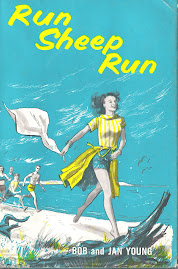
Well! Famous in New Hampshire! (At least among the shrinking number of people who still read newspapers.) Anyway, I think the universe is playing games with me. Because this weekend I was reading Sunday Dreamer by Bob and Jan Young, and in the middle of the book this fell out:


Could it be that for someone out there a grade school student ticket to a Mary College Marauders athletic event from 1970-71 has untold significance! I must find them! To the Google!


Monday, August 16, 2010

Raisin in the Arizona Sun

Title: Hold Fast to Your Dreams
Author: Catherine Blanton
Jacket: Harper Johnson
Publisher: Julian Messner, 1955
Setting: Blue Mesa (probably Tucson), Arizona
Provenance: formerly the property of Memorial High School, Newark, CA
Fun: the Fiesta of the Arts; a Hollywood producer-type who says "by gad"; tacos
Quote: Dorothea drew back. "Emmy Lou Jefferson, what a thing for you to say! You of all people. Remember this isn't just your battle or mine. It belongs to our generation. We may fail this time and even the next. But that doesn't mean we won't keep fighting."

Hold Fast to Your Dreams has a fairly familiar plot: Emmy Lou wants to dance, and in order to do so she must leave her small town for the wider world. The twist is that Emmy Lou is African-American, and this, too, would seem to make for a familiar plot. But Hold Fast to Your Dreams lacks the typical self-congratulatory tone of the social problem novel. For one thing, it was written in 1955. In 1955 the Montgomery Bus Boycott was still getting going. The Little Rock 9, the March on Washington, and the Civil Rights Act were all well in the future. (Even the play whose title I have ripped off for this post wasn't written until 1959.) In other words, there was no guarantee that segregation and institutional racism were going to disappear anytime soon. Hold Fast to Your Dreams gives us an America where attitudes vary widely and the future of what Blanton calls "the old, old argument" is unclear.
Emmy Lou takes the segregation in her hometown in Alabama, where she is her ballet teacher's only black pupil, for granted. She doesn't seek to challenge it, but to escape it, by moving to Blue Mesa, Arizona to live with her aunt and uncle. The school system in Blue Mesa is not segregated and Emmy Lou is befriended and accepted by a host of other students, both white and Hispanic. But Emmy Lou and her aunt are also turned away from a restaurant in Blue Mesa, and Emmy Lou's guidance counselor there suggests she give up the idea of becoming a professional dancer, telling her "for a Negro, it would be like batting your head against a closed door. Let's be realistic." Emmy Lou's father, aunt and uncle talk of patience as well: "...things are changing for us...we just have to learn to wait." Sit-ins and protest marches are in the future. Emmy Lou learns to swallow insults, including having the lead in the school ballet taken away from her after a parent complains.
In the end, Emmy Lou does fight, but she fights as part of a community. She is chosen for the lead in the Fiesta of the Arts ballet by a famous Hollywood director, but the head of the Fiesta (father of her friend Dorothy) refuses to sign the contract. Emmy Lou, Dorothy, and the other ballet students come together to fight for her, and it is then that Dorothy makes the remark I've quoted above: "This isn't your battle of mine. It belongs to our generation." Kind of prescient for 1955.

Sunday, August 8, 2010

In the Garden

Title: The Organdy Cupcakes
Author: Mary Stolz
Publisher: Harper & Row, 1951
Setting: Pre "Jersey-Shore" New Jersey
Provenance: formerly the property of the Butler Country Traveling Library
Fun: psychoanalysis; hats in the icebox; the daily drama of life and death.
Quote: "It was not an unfamiliar feeling, this one, for Gretchen had been more or less falling in love since she'd been fourteen. But not like this, she thought. Nothing like this at all."

The title and cover make more sense when you learn this book was later republished as Student Nurse.
The Organdy Cupcakes
takes us back to the days when nurses wore little paper caps, lived in residential dormatories with a matron, and dreamed of marrying doctors. Of the three girls -- Gretchen, Nelle and Rosemary -- only Gretchen achieves this, somewhat suddenly, at the very end of the book. Nelle marries a wealthy dilettante obsessed with Ancient Egypt (they don't make 'em like that anymore) while Rosemary dumps her doctor-boyfriend to join the Army nursing corps. (This is probably a wise move, since he has just psychoanalyzed her, which is a poor foundation for any marriage.)
Mary Stolz had a remarkable career, publishing her first YA novel in 1950 and her last in 1988, and negotiating the era of "serious topics" for young adult novels with some ease. She won Newbery Honors in 1966 for The Noonday Friends, which is the title that most rings a bell for someone of my generation. Style-wise, Stolz's novels are lush and dreamy, full of gardens and rain and glittering sunshine as the characters muse about their lives. As a child I found this kind of thing hard to follow, which is probably why I can't recall anything of The Noonday Friends now except the title. But as an adult I found The Organdy Cupcakes a beautiful book to read, particularly for its peaceful setting in small-town New Jersey before it became suburbanized. The details of hospital life are so well drawn that it's hard to believe that Stolz never trained as a nurse. (Stolz did suffer from severe arthritis in the 50s, so perhaps she drew her insights as a patient.) There aren't a lot of serpents in Stolz's gardens, but it's nice to see her characters moving into the adult world, knowing what they want for themselves.

Wednesday, July 21, 2010

The First Time

Title: The Tender Time
Author: Denise Cass Brookman
Jacket: Stanley Dersh
Publisher: Macrae Smith, 1958
Setting: An unnamed state where it gets down to -14 in the winter.
Fun: Coke dates; wearing his ring; ennui; a slimy best friend
Quote: "I hope..." her mother began, and began again, "I hope...that's not starting all over again."
"That," Stephanie said, putting on fresh lipstick, "can start only once."
"Don't be flippant, Stephie!" Then, anxiously, "It's over, isn't it?"
Stephie smiled at her mother in the mirror. "Finished. Not over." She turned around and kissed her lightly on the cheek. "There's a difference."

The main business of most teen novels is less romance than personal growth -- learning to ice skate, or that being popular isn't as important as being yourself, or that rich snobs ought to go back to New York City where they belong. Boys are dwelt on and sometimes chased after, but they aren't taken very seriously and are rarely allowed to clutter up the plot.

Not so The Tender Time, which looks squarely and unashamedly at romance in all its phases, from miracle of the first date to the glory of going steady to -- alas! -- the all-too-common sequel of terminal boredom:

"She tried to remind herself that though the old exhilaration was gone, so was the old depression and no-middle feeling. And simply because the exhilaration was gone didn't mean that love was, too. It really was much saner this way, she reassured herself. And yet..."

Brookman maintains a light tone but she misses very little. Scott, Stephie's boyfriend, is an egomaniac who refuses to believe a girl would actually break up with him. Stephie is so gullible she doesn't see her best friend is out to steal Scott. None of this is a tragedy, for Brookman, in spite of the title, isn't trying to write about true love. She's writing about that first high school relationship.

And in the oddly philosophical ending to the book, Stephie reminds her mother that though her relationship with Scott is over, it will never really end, because she can never fall in love with anyone else that way again:

"And that's how it didn't end...Always to be remembered, nothing ever to be remembered quite like that. No matter how many times the same things are done...Never the same as the first time, the young time, the tender time."

Tuesday, July 6, 2010

Ice Castles

Title: Skates for Marty
Author: Barbara Clayton
Jacket: Mimi Korach
Setting: Suburban Boston
Publisher: Funk and Wagnalls, 1959
Fun: Dates with Harvard men (was it really all right for high school juniors to date college guys?); Sadie Hawkins day; figure skating compulsories
Quote: "I know you've been through a great deal since her father died, but it's time you realized your daughter is growing up. Marty's too much of an introvert, and we've got to do something about it. Since she started school there hasn't been a sign of a friend and every afternoon she trots off to the library all by herself."
The incredulity of her mother's "No!" brought an even higher color to Marty's cheeks.

Starvation? Check.
"Then there was lunch - fruit salad instead of a banana split. 'Do you want to wear Chubettes or Junior Miss?' her mother had inquired. But now Marty felt hungry."
Strict foreign coach? Check.
"'You Americans are spoiled,' Josef laughed, 'In Europe we had to skate outdoors and I can remember one time at the Olympics when we did figures in an inch of snow.'"
Bitch rival? Check.
"'Another thing,' Marty put in, "If I don't look well, you won't either.'
Taff looked past her. 'And if I don't win the scholarship, you won't either.'"
Skating accident causing coma complicated by overbearing parental figure? Check.
"Far away Marty heard the fuzzy voices, then went back to weird dreams of skating down an unending rink. Skating...skating...always skating...Gram...skating...pushing...skating..."

I've just realized that all the horse novels I read a child had the same plot as Skates for Marty. Which is not to say that Skates for Marty isn't a lot of fun, though characters and scenes sweep by dizzily, never to be heard from again, and Marty is rather overloaded with good things at the conclusion. In fact, probably the most enjoyable thing about Skates for Marty is that she isn't really a great skater. She works hard, true, and eventually wins some kind of title, but she also falls down a lot, or gets so nervous she can't perform. Marty is, actually, a sensible girl who likes math. Early in the novel a character named Fred is introduced, who goes to MIT and encourages Marty to apply there. ("We need more girls," he says.) Fred turns out to be one of those characters who is whirled by -- we never see him again -- but Marty remains a ordinary girl who likes to ice skate. No matter what Gram and Mother imagine, I don't think she's been saved from a lifetime of trotting down to the library.

Monday, June 28, 2010

Little Monsters

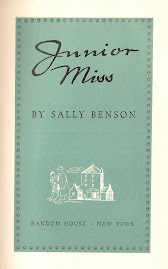
Title: Junior Miss
Author: Sally Benson
Publisher: Random House, 1941
Setting: New Yorker-land
Provenance: formerly the property of Marjorie Tremblay, a present from Cousin Albert, 1941
Fun: playing "Stepano, a drunken butler" in The Tempest; lily of the valley perfume; Pink Beauty, a (dead) trained mouse
Quote: "Look, Fuffy!" Judy exclaimed, "There's George Wade's house. Did you ever see anything like it? They haven't got a furnace or anything and they live there all winter. They throw their cans in the front yard. We can come down and get some if we want them for anything."
"They have lice," Lois said.

I bought the cheapest, most smudged copy available on Ebay and got a reward.
Sally Benson wrote the stories that were turned into the movie Meet Me In St. Louis. Those stories were originally published in the New Yorker, as were the Junior Miss stories. (Junior Miss was turned into a Broadway play which ran for two years and had a subsequent life as a movie, radio series and tv show.*) All this would lead one to believe that Junior Miss will be winsome and cheerful and all about the magic of being a young lady. This illusion is destroyed 4 pages in:

[Judy] was tall for her twelve years and heavily built. From her shoulders to her knees she was entirely shapeless, which gave her a square, broad look in spite of her height. Her summer tan had faded and her face had rather a ghastly yellow tinge. Below her skirt, which was too short for her, her legs were hard, muscular and covered with scratches. Her dress, a soft blue one, smocked at the sleeves, was supposed to hang gracefully...but instead looked as though she had been stuffed into it. She wore two rings on her fingers -- an aquamarine and a turquoise in gold settings. She had outgrown them and they drew her fingers in at their bases and made them look like sausages. She wore two charm bracelets of a brassy color and a locket and chain fastened so tightly around her neck it seemed it might throttle her. In the locket was a rather dim snapshot of a kitten and a clear picture of Tyrone Power. Her dark brown hair hung straight below her ears and was held in place by numerous bobbie pins and two ready-made bows. Her toenails, under her wool socks and scuffed brown oxfords, were painted with a decadent pink mother-of-pearl polish.
She sucked in her stomach, held her breath, and pulled her dress in at the waist. And, while the change in her silhouette reflected in the mirror was almost imperceptible, her eyes shone with a terrible optimism.

The reader is not being invited to identify with Judy, but to scrutinize her, and to discover that she's fat, vain and sentimental about kittens. This, I think, puts Junior Miss outside the realm of teen novels, one of the basic concepts of which is self-identification on the part of the reader. Junior Miss' origin in the New Yorker would seem to support this, but I can't for the life of me figure out whom the book was written for. Judy and her sister Lois think about little but nail polish, facials, beauty tips from magazines, and growing up as quickly as possible so they can wear stockings, perfume and "perfectly stunning" cruise clothes. Some writers can make this sort of thing charming, but Benson keeps sticking the knife in. The reader is made aware not just that these obsessions are frivolous but that they are complete failures. There's a moment in each story when one of the characters -- usually one of the parents -- will glance obliquely at the futility of life in general, and then smooth everything over and move on. Did sophisticated New Yorker readers in 1940 find this soothing? Did they think Judy and Lois amusing creations just like their own daughters? Did the irritatingly mournful comedy of the stories make them chuckle? I can't really answer that, any more than I can decide if this is a book you're supposed to enjoy or one to send a chill up your spine.


*Per Wikipedia, Junior Mints candy, introduced in 1949, was a play on "Junior Miss," which was still going strong on the radio at the time.