It's all about...popular girls...rec rooms...summers at the lake...dates with wealthy, thrill-crazy boys...black-market antiques...small town political corruption...and finding your true path in life. The Paris Hat considers the sometimes frothy, sometimes serious world of novels for teenage girls from the 1950s and 60s.

Friday, February 11, 2011

Life in a Northern Town

Title: Green Eyes
Author
: Jean Nielsen
Jacket: Mimi Korach
Publisher: Funk and Wagnalls, 1955
Provenance: Formerly the property of North Augusta (S.C.) Junior High School
Setting: Cascadeville, a lumber town in Washington
Fun: editing the school paper; self pity; rivalry; breaking your leg skiing
Quote: Jan turned on the water taps full force and shook in the soap flakes. She wouldn't always be doing dishes for other people. When fall came and she was editor she would be so busy she wouldn't have time to be home much and when that year was over she would go away. And she would make something of herself, too, because she had brains and willpower. If you didn't have brains all the curly hair and television sets in the world wouldn't give them to you.

Occasionally I'll run across a book that just stumps me. Usually it's because the book is a little dull and generic, but in the case of Green Eyes, it's just the opposite. Green Eyes is almost a perfect book. This is not the same as saying it's a great book or even that it holds up well against some of today's YA titles. But for the type of book I look at here -- girls' books about growing up from a more innocent era -- Green Eyes has got it all right. The heroine is realistic, the setting adds to the story, the writing is unobtrusive, and the story is based on character conflicts rather than a plot contrivance.

As might be guessed, Green Eyes is about jealousy. Jan, who is the new editor of the school paper, feels neglected at home, where her mother favors her spoiled younger brother. Spoiled younger brother had rheumatic fever a few years ago and is slowly being turned into what used to be called a "mama's boy." In a lesser book, the jealousy would be all in Jan's mind, and she would discover that her mother really loves her after all. Instead, as is made clear in a horrible Christmas Eve family argument, her mother feels trapped in a small town and would gladly clear out and leave Jan and her father behind.

Jan is also jealous of the new boy in school, Danny. Danny is from Seattle, and was editor of his high school paper there and the assumption is made that he ought to be editor in Cascadeville as well. Even after Jan fights off this threat and Danny seems to be less a rival than a potential boyfriend, Jan can't quite conquer her competitive feelings.

But even if Jan's reasons for jealousy are quite real, the conflict in Green Eyes is between Jan and herself. Nielsen quietly leads Jan through several experiences -- a school trip to Seattle, an assignment interviewing elderly residents of the community, a difficult winter -- that make her a stronger person and give her the ability to overcome her self-absorption. The one false note is that, at the end of Green Eyes, Jan is unrealistically given a plethora of good things: a college scholarship, a meaningful relationship with Danny, and a part-time job on a Seattle newspaper. But it's hard for the reader to think she doesn't deserve it.

Friday, January 28, 2011

Poetry and Iron

Title: Always Anne
Author: Holly Wilson
Publisher: Julian Messner, 1957
Jacket: Georgeann Helms
Setting: Henry's Bend, on the shores of Lake Superior
Provenance: Formerly owned by Sue Greane, 11th grader
Fun: fashion design contest; poetry contest; an accidental dip in the lake; plagiarism; grand larceny
Quote: "Honey Bunny!" warbled an excited voice at her elbow, and there was Glory Hoffman beside her...

Holly Wilson also wrote The Hundred Steps, and like that book, Always Anne is set in the Upper Peninsula of Michigan, in a town dominated by the Great Lakes shipping trade. While The Hundred Steps focused on class divisions (literally), Always Anne is a more conventional high school story, with a best friend, a sneaky girl rival, and a nice-looking boyfriend caught in between.

Always Anne is also an I-want-to-be-a-writer book, with a difference, for Anne is the first heroine of this period I've run across whose secret wish is to be a poet:

That night she went home inspired, and before she went to bed she wrote a poem which she thought was the best she had ever done...the thing that pleased her about it was that, at last, she had managed to convey the feeling she had been searching for -- the change in the middle of the sonnet that had eluded her for so long. Now she understood it. In the first eight lines you said something important, then, in the last six line you came to a conclusion about it. That was the way to do it.

Always Anne moves along quickly and the plot provides a fair amount of drama in the person Glory Hoffman "the femme fatale of Henry's Bend High School," who eventually departs the story in a trail of bad debts and dropped charges. Anne heads off to the University of Michigan -- probably to have her notions about sonnets changed forever -- and Tom, her boyfriend, takes a job on an ore carrier for the summer. As with The Hundred Steps, this is a book to make you fall in love with the Great Lakes.

Wednesday, December 29, 2010

Girl Interrupted

Title: A Girl Like Me
Author: Jeannette Eyerly
Publisher: Lippincott, 1966
Jacket: Ellen Raskin (yes, that Ellen Raskin)
Provenance: Formerly the property of the Burnsville branch of the Dakota County (MN) Library System
Fun: Less than Zero, circa 1966
Setting: An unidentified town on/near the Mississippi River
Quote: If it was a baby, what would Cass do? She'd said her father would kill her. Of course, he would not. But Robin shivered, remembering the one time she'd seen him.

In magazine stories of the "True Confessions" type, up until the 1950s, giving a baby up for adoption was almost always portrayed as morally suspect -- an attempt to disown one's responsibility and erase one's past. In the 1950s, for various economic, social and psychological reasons*, the wind swung around suddenly. Adoption was now presented as the best solution for all parties -- the baby could go to a good home and the unwed mother could start a new and better life, her secret forever protected.

This second attitude forms the core of A Girl Like Me, which is partly set in a home for unwed mothers. Eyerly wants to write about her subject in a clean, unemotional and unsensational way, and she creates two typical characters -- Robin, a studious good girl, and Cass, a more popular type. Cass fixes up Robin with Randy, best friend of her boyfriend, Brew, and they make the rounds of decadent suburbia -- necking spots, beer joints and parties with loud "thumpy" music and no parents. Robin's own parents eventually intercede, forbidding her to see Randy, but it's too late for Cass, who turns up sick in the ladies' room in the middle section of the book.

From this point much of the book is standard -- a humilating visit to the doctor, Cass' banishment to a maternity home, rumors at school -- but Eyerly continues her crisp style at least until the last section, when Robin, who knows that she's adopted, attempts to find out something about her own parents.

A Girl Like Me is clearly a well-meant attempt to treat an important topic in a realistic, non-sleazy way, explore a complex issue facing teens today, etc, etc. The problem is that it probably wasn't possible, in 1966, for a reputable writer like Eyerly to plunge fully into the sticky business of adolescent desire. Unlike the books that Judy Blume would be writing 10 years in the future, Cass and Robin don't seem to have bodies or feelings. Randy and Brew are basically bullies and the reader has to wonder why the girls go out with them at all. And yet in some ways the book still holds up. It has the ring of the modern world: a character drives a Volkswagen, ESP is mentioned, and even the P word -- period -- is flung out casually. Robin, who defies both Cass' parents and her own to visit her in the maternity home, is an appealing character. Maternity homes are gone, and with them the unquestioning acceptance of adoption as the best thing an unwed mother can do, but I can see girls today still identifying with Robin and Cass.


*Detailed in Rickie Solinger's book Wake Up Little Susie: Single Pregnancy and Race before Roe v. Wade

Thursday, December 16, 2010

Love the One You're With

Title: River At Her Feet

Author: Zoa Sherburne
Jacket: Joseph Cellini

Publisher: William Morrow, 1965
Provenance: Formerly the property of Thelma C. Holden of Roanoke

Setting: Clarksburg, USA
Fun: being a bridesmaid; a musical prodigy
Quote: "The flowers came," Francine announced in reverent tones. "They smell simply beautiful and Mother cried when she saw them."
"Mother," Elizabeth reminded her younger sister glumly, "has been known to cry at pep rallies. What else is new?"

Although I had heard of Zoa Sherburne, I read this book partly because I saw her name on Peter Sireuta's Collecting Children's Books blog, where, along with Jean Nielsen and Amelia Walden, she was mentioned as YA writer from what he calls a "lost generation." After reading River at her Feet, I would describe Sherburne as a transitional writer, looking ahead to the kinds of books I often read growing up in the 70s: "problem novels," yes, but ones that focused on emotional situations rather than divorce, alcoholism or some of the more "angsty" issues.


River at Her Feet takes its theme from the once-familar Longfellow poem Maidenhood: "Standing with reluctant feet/Where brook and river meet." Interestingly, I've read some criticism that these lines, which are also quoted in Anne of Green Gables, are a coded reference to physical maturation of adolescence. (Oh, those literary critics and their filthy minds!) In any case, Sherburne focuses strictly on the emotional growth of her heroine, Elizabeth Stacy. At loose ends after her older sister's wedding, Elizabeth, 16, develops a crush on Eric Killian, piano prodigy and visiting celebrity, who happens to be 24.


What follows is a little shocking to tender modern sensibilities. Eric and Elizabeth date, though very chastely. They take long walks and go boating and once even go to a formal dance. Elizabeth's parents frown but take a hands-off approach. (We eventually learn that this is because they know that Eric has a steady girlfriend his own age in his hometown.) Sherburne handles this so well the reader doesn't ask some rather obvious questions about how damaging these emotional cross-currents might be. And River ends cheerfully, with Elizabeth turning down a last date with Eric to spend time with her family. If River at Her Feet is a transitional novel, looking ahead to some of the tougher subjects that will be tackled later in the decade, emotionally it's still back in the past -- with Longfellow -- viewing adolescence as a time of rapture, growth and innocence.

Monday, November 29, 2010

Year of Living Tamely

Title: Senior Year
Author
: Anne Emery
Publisher: Scholastic, 1964 (paperback reprint, originally published 1949)
Provenance: Formerly the property of Elena Sipp
Setting: a small town so generic it doesn't even have a name
Fun: plant sitting; babysitting; church youth group; "Captain Midnight" on the radio
Quote: In the garden she chose white and yellow chrysanthemums and achieved an arrangement in a low yellow bowl before Jean finished the table. Then she discovered that Jean had used pink placemats and refused to change them just to carry out Sally's color scheme. "All right then," said Sally, with conscious patience, "only it would be nice to have the first dinner at home as perfect as possible."

Senior Year was published in 1949, a fact that becomes obvious when someone asks Sally if she likes her music "smooth" or "hot" (i.e., Bing Crosby or Glenn Miller style.) I have to wonder if the kids who picked up this book in 1964 weren't confused by that, or if the absence of rock'n'roll didn't matter to them. Interestingly enough, this must be the fifth or sixth book in which some of the characters listen to folk music (in this case Sally's parents, who go in raptures over John Jacob Niles.) In other books it's been the teens who listen to it. I know that folk had a vogue in the early 60s, but I sometimes wonder if it isn't the adult writers putting their own tastes onto the characters. In any case, I've never run across a book from this era yet with any appreciation for rock'n'roll.
It's hard to say exactly what the main plot of Senior Year is. There's a Mr. Right and Mr. Wrong, a fast boy called Eddie who takes Sally to a sleazy bar. There's a somber subplot involving a sister who gets rheumatic fever (also probably anachronistic by 1964) and spends months in the hospital. Bills pile up, and at the end of Senior Year Sally is told by her parents that they can't afford college for her unless she goes to the local state university. Sally doesn't object to the educational qualities of this institute, rather:

"Everyone she knew was going away. There wouldn't be anyone left in town. It was the one tragedy she had thought wouldn't happen to her."

Sally cheers up, eventually, when she learns that Mr. Right will be going to college locally, too.
There is a vague stirring behind all this action which seems to suggest that Anne Emery wants Senior Year to be about growing up and thinking of things beyond your own narrow viewpoint -- e.g., giving up the dream of attending a certain college when you realize you little sister may be crippled for life. But it doesn't really feel like that. It feels more like settling for less and pretending you like it.
Which, as a concept, was also pretty anachronistic by 1964.


Thursday, November 4, 2010

Washington is for Lovers

Title: Cherry Blossom Princess
Author: Marjorie Holmes
Publisher: Westminster Press, 1960
Jacket: not credited
Setting: Glamorous Washington D.C.
Provenance: formerly the property of the Sacramento County Library
Fun: Shopping, parades, politics, revenge
Quote: "Where in the world did you get all this stuff?" was all that Marty could think to exclaim.
"Oh, hither and yon," Kitty said, hanging her mink jacket in the hall closet..."The rug's a genuine Saruk. We got it in Bagdad for a song. That inlaid mother of pearl cabinet's a present from Madame Chiang Kai-Shek. The tray's from Haile Selassie. The Delft clock -- isn't it cute, all the moving figures? -- is from the Dutch queen."
If you look up Marjorie Holmes on Ebay or any other used bookseller website, you will find quite a lot of inspirational books, both fiction and non-fiction. Her young adult stuff is harder to find, and this book in particular is considered quite rare -- I've seen copies in top condition listed for $30 or $40. (I jumped on $13 for a ex-library copy in fair condition as a bargain.) My guess is no one can resist either the title or the cover.
In real life, Holmes lived in Washington DC, and between books she wrote a newspaper column on family issues*. She came from Iowa, and she gives this same origin to Marty of Cherry Blossom Princess. Marty is sent to visit her aunt and uncle (a VIP in the State Department) in DC to get her mind off being dumped by her boyfriend, Don. In a matter of pages, her aunt and uncle fix it up that Marty will be Iowa's entry into the Cherry Blossom Princess festival, and in another trice Marty has 1) boy next door Mike, 2) charming but engaged official escort Skip, 3) poor old Don, whose high school band has come to Washington to participate in the festival, all trailing after her.
The great success of Cherry Blossom Princess is in its Cinderella evocation of a certain phase of adolescence: on the verge of being an adult and yet still only pretending to be one. Marty and her various escorts and boyfriends go to restaurants and dances and "parties in someone's apartment in Georgetown"; they roam Washington after dark, gazing at the monuments and uttering civics-class sentiments. Marty cries into her pillow at night and spends hours waving from a parade float the next morning. It's a whirlwind of glamor, heartbreak, springtime and emotional exhaustion. And yes, I was a tiny bit jealous, though I remember that feeling well. (A Marriott Hotel in Louisville, Kentucky can seem mighty glamorous when you're seventeen.)
Eventually the party ends and Marty walks off with Mike, glad to be over Don and free of Skip. You get the feeling, though, that Iowa will never seem the same.

 
*ETA:  I did not do my research properly on Holmes.  She was best known as the author of Two from Galilee (1972), the first of a trilogy about the courtship of Mary and Joseph and the adolescence of Jesus.  Two from Galilee is very reflective of an era in which the humanity of Jesus as an ordinary person was often stressed (see Godspell and Jesus Christ Superstar, for instance.)  Let's just say the book is sort of...earthy, although any book in which the Virgin Mary gets her period on the first page  deserves some credit, I think.
-- August 2014

Thursday, October 21, 2010

West Coast Story

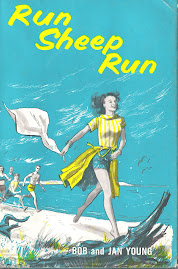
Title: Sunday Dreamer
Authors: Bob and Jan Young
Publisher: Julian Messner, 1962
Setting: Seaside Cordoba, California
Provenance: unknown, but sometime around 1971 was owned by someone who lived in Bismarck, North Dakota
Fun: Grandma vs. the zoning board; school rivalry; vandalism
Quote: "For years we've prided ourselves that Cordoba didn't have a juvenile delinquency problem but this situation between the high schools is getting out of hand. It's beginning to look more and more like some of that outright gang warfare you hear about in the big cities."

Do people still write books about girls who just want to be popular? How exactly did it come about that popularity became synonymous with evil and the popular girl a cardboard character who represented every negative value? As I remember high school the popular girls were flimsy, airheaded creatures who didn't bother much with girls like me (something I didn't resent) and who hardly had the impetus or time to go around destroying the lives of lesser mortals, or even saying nasty things to them. High school wasn't war, high school was indifference -- which can actually be much, much worse.
In books from this era, however, popularity is rarely portrayed as a negative thing. Every heroine wants to have lots of friends and be among the class leaders, all of whom are nice, normal girls. True, the occasional cat shows up in their ranks, but her sharp tongue usually causes her downfall before long. After all, who would want to be friends with someone who isn't nice?
So this brings us to Sunday Dreamer. Moving to Southern California from San Francisco, where she had one friend at school, is a fresh start for Nancy. Her grandmother's social position as foundress of the town ought to help, too. But Nancy tries too hard, she's too studied in her "witty" responses to friendly questions, she takes offense too quickly, and before you know it she's eating lunch all by herself in Cordoba, too.
Given that being popular is synonymous with being normal, no-one questions that Nancy is right in wanting it. She just has to go slow, and since this book is by the Youngs, Nancy's journey will involve something serious and thought-provoking. In this case, nursing. Nancy volunteers at the hospital, she brings in other girls to help, she unites two feuding high school gangs, and she pulls an all-nighter after a train accident. After all that, who the hell cares about being popular?

And thanks to Carole Anne Carr, who gave me a Literacy Builder Award this week. I posted my five favorite words and passed it on to three other bloggers on my other blog, Pray for Rain. Thanks again, Carole Anne.