It's all about...popular girls...rec rooms...summers at the lake...dates with wealthy, thrill-crazy boys...black-market antiques...small town political corruption...and finding your true path in life. The Paris Hat considers the sometimes frothy, sometimes serious world of novels for teenage girls from the 1950s and 60s.

Tuesday, May 18, 2010

Queens of the Genre, Part I: Maud Hart Lovelace

Title: Emily of Deep Valley
Author: Maud Hart Lovelace
Illustrations: Vera Neville
Publisher: Thomas Y. Crowell, 1950
Setting: Deep Valley (a.k.a. Mankato), Minnesota
Fun: Little Syria; frog legs; the Browning Club; the election of Woodrow Wilson
Quote: "I'm through high school, I'm finished with something, but I'm not beginning anything. That's wrong. When you finish something, you always ought to begin something new. But I'm just going to go on doing housework, looking after Grandpa."

I have never counted myself a huge fan of the Betsy-Tacy books. Perhaps it was growing up in the 1970s, but I always felt there was something pallid about the whole series. Betsy never has any problems that can't be solved by going on a picnic and I think there is one recorded instance, in the whole ten books, where she says something not-very-nice about another girl. But one aspect of Betsy-Tacy has always seduced me, and that is the idea that to stand on the verge of adulthood about 1912 or so must have been bliss. Psyche knots, watch bracelets, organdy dresses, the Philomathians, Class Day, the Junior-Senior banquet -- all the girls happy and self-confident, the boys full of mischief and fun -- the entire insular American world at their feet.

Emily is a spin-off of Betsy-Tacy. Set in the same town, and full of off-hand references to Betsy Ray and Tib Mueller, it is also a little darker, as if Lovelace wanted to rework some of her earlier themes in a more realistic way. For Emily Webster, unlike Betsy, has problems that can't be solved by going on a picnic.

Emily has been raised by her grandfather, a Civil War veteran who lives mainly in the past. He sees no sense in sending Emily to college -- he thinks he was generous to let her finish high school. Unlike Emily's high-school friends, who troop happily off to the "U" anticipating sorority rushes and all kinds of fun, Emily knows that college would really mean something to her -- she wants to be a sociologist, like her idol, Jane Addams. Instead she is left in Deep Valley as winter comes on, without a friend, male or female, her own age.

Emily, however, does not repine. She buys a new hat, begins formal study of the works of Robert Browning, and learns to do the "Gaby Glide." And she takes a look at the community around her, including the Syrian immigrants who live on the wrong side of the slough. There's a notable anti-immigrant feeling in Deep Valley, but Emily, with the help of handsome, interesting, Jed Wakeman, organizes a boy's club as well as citizenship and English classes for the adults.

None of this comes easily. Lovelace was good at drawing scenes of adolescent fun and friendship -- sleigh rides, sing-a-longs, skating parties. In this book she inverts the usual: the most painful scene in the book occurs when Emily sits through such a sleigh ride with an unwilling date, knowing she doesn't fit in and detesting the silliness of the girls she has been friends with all through high school:

"[Their] talk would be about their colleges, their new experiences. She had had new experiences, too, she thought with proud resentment, but when she was with the crowd they seemed to be of no importance. It was true even with the girls...She wasn't tired of her friends, but she was tired of pursuing them as though her own life were worthless."

By the end of Emily of Deep Valley, the last tie to her old crowd has been cut when she turns down the patronizing Don for Jed Wakeman. They will stay in Deep Valley, Jed teaching, Emily continuing her work with the Syrians. In the Betsy-Tacy books, "the crowd" is a source of strength -- a rock of friendship in the tumult of life. But Emily creates a satisfying, independent life for herself only by growing beyond the crowd. I never read Emily of Deep Valley as a child -- as it wasn't part of the regular Betsy-Tracy books the Lexington library didn't have it.* But if I had I think it would have redeemed the entire series for me.

*By some miracle, the Henderson Public Library, which does not have most of the upper books of the Betsy-Tacy series, has a 1950 first printing of Emily of Deep Valley. So far they have not cast it off onto the "Pages for Pennies" shelf.

Monday, May 3, 2010

The Original: Maureen Daly

Title: Seventeenth Summer
Author: Maureen Daly
Publisher: Dodd, Mead, 1942 (Currently available from Simon and Schuster)
Setting: Pre-Pearl Harbor Fond Du Lac, Wisconsin
Fun: Beers at Pete's; Cokes at McKnight's drugstore; the bakery truck; meeting the train.
Quote: "It's almost like a secret police system -- no one escapes being checked on. At least no one who counts. The checkers keep their eyes open for new prospects among the young sophomore girls who are growing up and showing signs of datable promise. They only watch out for the very pretty or very popular girls, so it is the most serious catastrophe of all not even to be noticed by the checkers...Most of them didn't know my name until I began to date Jack."

In 1941, Maureen Daly, a college student, wrote a novel about a girl who falls in love with a boy just outside her social circle. Published a year later, Seventeenth Summer became the first "young adult" novel -- targeted specifically to girls too old for Nancy Drew but unwilling to read adult literature. More simply put, Maureen Daly established the genre I write about here. But Seventeenth Summer is more than some obscure 1940s novel. It's a classic work -- a beautiful, subtle and haunting story which distills, moment by moment, the suspense of adolescent love, the cross-currents of family life, and brevity of the Wisconsin summer, all against the background of small-town life in the months before World War II.

Nominally, Seventeenth Summer is about the relationship between Angie Morrow and Jack Duluth, who comes into her life because he drives the bakery truck. Although the social gulf between them is not immense, Jack has no prospects beyond the bakery, while Angie is going to college at the end of the summer. In actuality, much of the book is caught up with Angie's observation of her family-centered life. She is poised between the brand-new idea of what independence with Jack might mean and regret at the disruption of everything she knows. She observes other teenagers at roadhouses and keg parties with the distance of an anthropologist, preferring the structured world of her close-knit family. And yet she can't quite turn away from the thrill of Jack. One of the things that marks Seventeenth Summer as "young adult" is that Daly acknowledges Angie's physical attraction to Jack:

His shoulders above the water were smooth and brown, shiny with the wet, and when he moved the muscles in his arms made a barely perceptible ripple. He swam out a short distance, and then signaled me to come in.
Why is there always that self-conscious feeling about looking at a boy in swimming trunks?

I had always thought it was something like voting, that you weren't really supposed to start feeling with your heart till you were at least twenty-one. And here I was looking at him so hard I could almost feel myself seeing the clean, wet look of his crew cut and the familar coarse knit of his football sweater, while my heart was pounding till it made my voice quavery.

Although Angie politely refuses to elope with Jack, at the end of the summer she leaves Fond Du Lac for the outer world he represents.

Maureen Daly never wrote another teen novel. She married a journalist and later wrote about her travels with him, as well as some books for younger children. If Seventeenth Summer was to a large extent drawn from her own life -- and it reads that way -- this is understandable. The teen writers who came after her would be more prolific, and more professional, but also shallower and lighter. But the same themes established by Daly -- the pull between family and independence, the thrill of attraction, and the quest to grow up, would be at the center of them.

Friday, April 23, 2010

Behind the Scenes at the Card Shop

Title: A Valentine for Vinnie
Author: Marjory Hall
Publisher: Funk & Wagnalls, 1965
Cover art: unknown
Setting: a unnamed state with fogs, long winters and towns with names like Rock Harbor and Pine Bay
Provenance: formerly the property of the West Bend Public Library
Fun: inside knowledge of the retail card biz; college weekends; queer old maids
Quote: "Halloween!" she said aloud. "Who ever heard of a such a thing? I never sent a Halloween card, and I never got one either."

Vinnie works in a card shop. After a slow beginning, she discovers that she likes the card shop. She has ideas about the card shop. A new window display, for instance, and better inventory procedures. And the aforementioned Halloween cards. Then there's the good looking salesman (alas, married) who stops by and befriends her. And Ted -- her crush since high school, who comes in to buy a card as well.

Marjory Hall began her writing career in the 1940s, with maltshop romances, and A Valentine for Vinnie seems closer to that era, and genre, than its 1965 publication date would indicate. There is a college weekend -- driving up to meet a date for the big game and a dance -- and a subplot about building the new country club. Vinnie, though not terribly insightful, is pure-hearted and hopeful. But maybe Hall was, by 1965, a little tired. Certainly by about half-way through Valentine she has lost interest in Vinnie. You hear less about the card shop, and more about new characters. And then Ted invites Vinnie to a college dance, and, the day before the dance, uninvites her -- not even in person, but by letter. This could have been the book's emotional core. Instead, Vinnie just has a good cry and decides it's all for the best:

"Her great devotion to Ted had put blinders on her. She hadn't enjoyed the good things, or the right people, all this time. Hal, for example."

Exactly 22 pages later Hal is giving her his pin.

Monday, April 12, 2010

So You've Ruined Your Life

Title: April Wedding
Author: Eve Bennett
Publisher: Julian Messner, 1959
Cover art: unknown
Provenance: formerly the property of the Grand Forks (ND) Public Library
Setting: Adolescent Denver
Fun: Teen Times radio show; selling insurance door to door, teenage motherhood
Quote: "Bill's somber eyes stared straight ahead. 'They might feel that their trust is betrayed if we go on like this. Jeannie, you know as well as I do what ails us. We either ought to give each other up, or we ought to get married.' "

You've probably seen this after-school special. High school seniors, deeply in love, decide to get married. A year later they're broke, living in a squalid apartment with a screaming baby. Boy begins to drift away, hanging out night after night with the guys. Girl turns into a nag with hair curlers and a rolling pin. Divorce, and a lesson for us all, are just around the corner.

It could be that Eve Bennett is just a little too independent-minded to accept this script. Or possibly she just doesn't want such bad things to happen to two nice characters like Jeannie and Bill. Certainly the major plot points are there, portrayed with Bennett's usual wit and realism. A courthouse wedding, a run-down apartment, Bill selling insurance door to door to pay the bills, followed by Bill quitting several jobs and being jealous of Jeannie working, topped off by Jeannie becoming pregnant and hating it. Bennett doesn't skimp on the reality of morning sickness, mood swings and the uncertainty of taking care of a first baby.

But Bennett is not trying to scare her audience straight. Sure, babies cry and pregnancy makes you feel unattractive, but there's always the possibility that your husband will come home on your birthday with a new dress ("smoke-gray pleated nylon skirt spangled with velvety black flowers and sparkle dust") and take you out to dinner. And that, after a year of ups and downs, your father-in-law, impressed by your commitment, will offer to pay for college for both of you. As Bennett comments on the back of the book, she is not "usually in favor of teen-age marriages...[but] I think most marriages could be worked out if both parties really tried, and the one thing on the side of young marriages is that youth is more resilient."

Is Bennett painting an over-optimistic picture? If the after-school-special version of the tale is grimmer than it needs to be, in order to sell the lesson of the story, is Bennett, working in the confines of popular fiction, bound to put a happy ending on things for the same reason? The answer is probably yes. But all any writer can do is try to describe the world as they know it, and that's something Bennett does very well.

Thursday, April 1, 2010

The Right Sort

Titles: Then Came November; When Debbie Dared
Authors: Nan Gilbert; Kathleen Robinson
Publisher: Whitman, 1963
Cover art: Olindo Giancomini; Jim Tadych
Settings: Fairhills, a small town turned suburb; Karidale, a suburb of St. Louis
Provenance: "Helen Snyder" written inside front cover, raised seal on first page "Library of Ernestine L. Snyder."
Fun: homegrown watercress, fear of heights, going deeply into debt for the perfect coat.
Quote: "This is authentic Fraser plaid, woven in Scotland especially for our clan. I believe the firm now offers it for general sale, if your mother is interested in ordering, but whether they maintained the quality of the wool, I couldn't say--" (Then Came November)
"[Merry] was the only girl in Karidale to have ridden to hounds." (When Debbie Dared)

This was an era when class struck terror into the hearts of millions. In book after book, heroines are acutely aware of their social position, marked by such things as Chinese salad bowls, pedigreed dogs, and where they summer, as well as proximity to horses and booze.
In these two Whitman teen novels, Then Came November, and When Debbie Dared, Dulcy Rolff and Debbie Robyne both run up against snaky girls who, while pretending to be their friends, are secretly snobs. In Dulcy's case the motivation is Dulcy's superior social position. Dulcy is not wealthy, but her family bears a pioneer name in the town and gets frequent mention in the society column. As Elaine, the snake, puts it:

"Rolffs don't have to be rich. They don't have to butter people up and pull strings and -- don't you think I get sick, sick of watching Mother do it, every new town we go to?"

Dulcy, previously shy, and not blessed with a lot of foresight (she nearly kills her dog by giving him sleeping pills so he won't bark when she sneaks out) is completely suckered by Elaine, who shows her how to open a charge account ("just give them your father's name") and then, when she is in trouble at home and school, steals her boyfriend.

Debbie, on the other hand, is an ordinary soul taken up by Carlotta, a "New York girl" whose father has been transferred to Debbie's hometown. " 'Personally,' " Carlotta says, "with a twist of golden bare shoulders, 'I think it's gauche to dine early.' " Fortunately, Carlotta mispronounces gauche, and Debbie becomes disillusioned with her. Carlotta is also driven to a jealous fit when another senior girl drops out to marry her fiance, a West Point cadet. (The lucky thing -- she gets to start her married life on an army base in West Germany!) It turns out that she only cultivated Debbie to get her help on her French homework. Carlotta ends up alone and unloved, while Debbie rides the ferris wheel at the state fair with her new boyfriend -- the son of an orthopedic surgeon.
While it might seem that the common folks prevail, in fact neither Dulcy nor Debbie questions that there are certain things one ought to have or aspire to. When Debbie looks over her mother's dinner table before a party, she sees her grandmother's silver candlesticks, Calyx dinner ware, a linen tablecloth and "unmatched flat silver, all old and much of it worn thin." Dulcy, for her part, is comforted by her family's loyalty to anyone in trouble.
As for poor familyless Elaine, she and her Mother will evidently have to once again move to a new town and start pushing their way in among the right people.

Tuesday, March 16, 2010

From Surfer Girl to Science Nerd

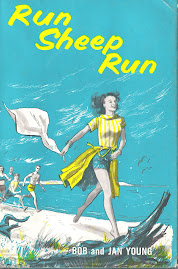
Title: Run, Sheep, Run
Authors:
Bob and Jan Young
Jacket illustration: Jon Nielsen
Publisher: Julian Messner, 1959
Setting: The coast of California
Fun: hoodlums on motorcycles; paying for college by selling smoked fish; up close and personal with sea anemones
Quote: Sue had warned the idea would be startling, but Judy was hardly prepared for that murmur of surprised voices. "A party?" Derek looked flabbergasted, "But the Science Society never has parties."

The Youngs often picked important topics for their books -- political corruption in One Small Voice, prejudice against Hispanics in Across the Tracks. Run, Sheep, Run's topic is the social prison that is high school, or, how "society's demands for conformity often crushes the individual's courage."

Judy Cannon starts out as a member of a crowd of young people who hang out on the beach all summer and who consider anyone who gets good grades an "apple-polisher" and teacher's pet. Judy's first error is taking biology and liking it. Then, in a mild setback to her social life, her mother gets sick (the doctor doesn't say exactly what she has, but it has something to do with her working in an underground bank vault all day) and the family moves to a house on an isolated point, the better for sea air and sun. Judy becomes fascinated by tide pools, helps out with her family bait business and, the final straw for her friends, joins the Science Club.
It turns out, however, that the Science Club members are just as set in their ways as her former friends. Tall, blond Derek, who had seemed so friendly on that field trip to the marine biology lab, now tells Judy, "the student who is seriously interested in science hasn't time for other interests." Hmm. Were this a B-movie, Derek would end up rescuing Judy from a Giant Crab Monster and would indeed discover that he has other interests. Instead, Derek skulks off, aloof scientist to the end, and Judy's old crowd gradually comes back into the picture. They've grown, too, and they kind of admire Judy's independence.
Is it a little odd to write about social conformity by setting a novel amid bait shacks and marine biology labs? Yes, but it's the kind of thing the Youngs were good at. There's something grandly optimistic about Run, Sheep,Run, and like One Small Voice, it belongs very much to its time. I sometimes wonder if along about 1970 or so the Youngs weren't wishing they could put the non-conformity genie back in the bottle.

Friday, March 5, 2010

Regionalism

Title: The Hundred Steps
Author: Holly Wilson
Jacket Artist: Albert Orbaan
Publisher: Julian Messner, 1958
Setting: "Clifton" (Marquette), Michigan
Provenance: Unknown
Fun: Pyromania; sea chanteys; berry-picking interrupted by a bear
Quote: "Flannelmouth!" said Susan, and she went off into a burst of giggles that infected the group around her. They laughed heartily and slapped each other on the back, repeating, "Flannelmouth! You're all a bunch of flannelmouths!"

One of the nice things about many of these 1960s teen novels is that instead of being set in the bland suburbia we associate with that era, they are actually grounded in specific places -- like the California desert town of One Small Voice -- and so draw a nicely detailed picture of particular American regions. The Hundred Steps is dominated from page one by its setting in Clifton (evidently based on Marquette), Michigan. The steps of the title lead from the Lower Town, home of the fisherfolk, to the Upper Town, home of the iron ore millionaires. Marcy McKay lives in the Lower Town, naturally, and her father works on an ore carrier, shipping cargo across Lake Superior. The lake is as important as any other character in the book, and the climax of the novel is a shipwreck and rescue in Clifton Harbor. This event brings together the Upper and Lower Towns and smooths out the class divisions that form the major theme of The Hundred Steps. Marcy has begun hanging out with Upper Town girls, although she's not sure they really accept her. The Upper Town is epitomized by wealthy pyromaniac Walt Hamilton*, who tops off a date with Marcy by setting fire to the town's ski slide. The police investigation of this provides the drama of the first part of the book, though the eventual court case is anti-climactic. Then, after a couple of filler chapters, a big storm blows through, Marcy's father's ship runs aground and Walt proves a decent person after all. (Walt is not actually the hero of the novel, safe and less interesting Bill Carlson is.) And if you don't want to go on vacation to the Upper Peninsula of Michigan after reading this novel, something is wrong with you.


*Walt seems to be the name of choice for male characters. Other books with Walts: One Small Voice, The Paris Hat. Perhaps it was the Disney influence?